Конструктор уроків
- Всеосвіта›
- Бібліотека уроків›
- Англійська мова›
- The Participles 11 form (18.04)

Урок:
The Participles 11 form (18.04)

17.04.2022
Вміст уроку:
1
2
1
Monday, the 18-th of April
Class Work
Hello everybody!
At this lesson we continue talking about THE PARTICIPLES.
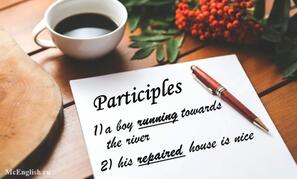
Participle clauses enable us to say information in a more economical way. They are formed using (запишіть у зошит)
present participles (going, reading, seeing, walking, etc.),
past participles (gone, read, seen, walked, etc.) or
perfect participles (having gone, having read, having seen, having walked, etc.).
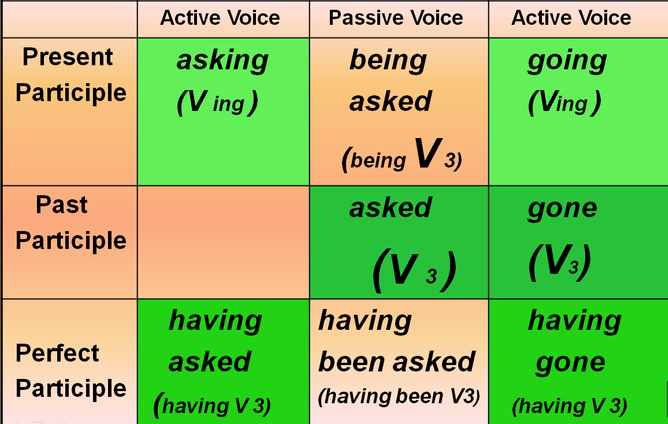
We can use participle clauses when the participle and the verb in the main clause have the same subject.
For example:
Waiting for Ellie, I made some tea. (While I was waiting for Ellie, I made some tea.)
Отож, переглянемо ще раз форми дієприкметників.
Випиши в зошит приклади з present, past and perfect participles (обговоримо їх у Zoom - conference)
Present participle clauses
Here are some common ways we use present participle clauses. Note that present participles have a similar meaning to active verbs.
To give the result of an action
The bomb exploded, destroying the building.To give the reason for an action
Knowing she loved reading, Richard bought her a book.To talk about an action that happened at the same time as another action
Standing in the queue, I realised I didn't have any money.To add information about the subject of the main clause
Starting in the new year, the new policy bans cars in the city centre.Past participle clauses
Here are some common ways that we use past participle clauses. Note that past participles normally have a passive meaning.
With a similar meaning to an if condition
Used in this way, participles can make your writing more (If you use participles in this way, … )To give the reason for an action
Worried by the news, she called the hospital.To add information about the subject of the main clause
Filled with pride, he walked towards the stage.
Perfect participle clauses
Perfect participle clauses show that the action they describe was finished before the action in the main clause. Perfect participles can be structured to make an active or passive meaning.
Having got dressed, he slowly went downstairs.
Having finished their training, they will be fully qualified doctors.
Having been made redundant, she started looking for a new job.
Participle clauses after conjunctions and prepositions
It is also common for participle clauses, especially with -ing, to follow conjunctions and prepositions such as before, after, instead of, on, since, when, while and in spite of.
Before cooking, you should wash your hands.
Instead of complaining about it, they should try doing something positive.
On arriving at the hotel, he went to get changed.
While packing her things, she thought about the last two years.
In spite of having read the instructions twice, I still couldn’t understand how to use it.
2
Now it's time to practise!
Let's do the test on Participles


17 квітня 2022

Рефлексія від 8 учнів
Сподобався:
0
Так: 7
Ні: 1
Зрозумілий:
0
Так: 6
Ні: 2
Потрібні роз'яснення:
0
Ні: 6
Так: 2
