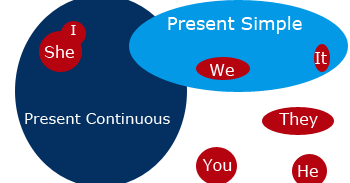
The difference between Present Simple and Present Continuous
Конструктор уроків
- Всеосвіта›
- Бібліотека уроків›
- Англійська мова›
- Present Simple vs Present Continuous

Урок:
Present Simple vs Present Continuous
23.12.2021
Опис уроку (учням цей опис не показується):
Вміст уроку:
1
2
1
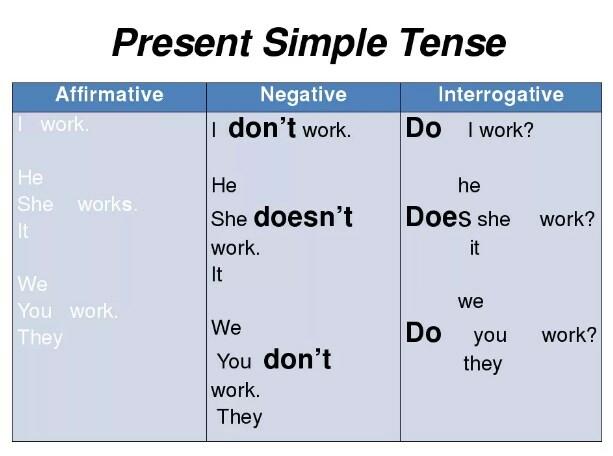
PRESENT SIMPLE
We use the present simple when something is generally or always true.
People need food.
It snows in winter here.
Two and two make four.
Similarly, we need to use this tense for a situation that we think is more or less permanent. (See the present continuous for temporary situations.)
Where do you live?
She works in a bank.
I don't like mushrooms.
The next use is for habits or things that we do regularly. We often use adverbs of frequency (such as 'often', 'always' and 'sometimes') in this case, as well as expressions like 'every Sunday' or 'twice a month'. (See the present continuous for new, temporary or annoying habits).
Do you smoke?
I play tennis every Tuesday.
I don't travel very often.
We can also use the present simple for short actions that are happening now. The actions are so short that they are finished almost as soon as you've said the sentence. This is often used with sports commentary.
He takes the ball, he runs down the wing, and he scores!
Future Uses
5: We use the present simple to talk about the future when we are discussing a timetable or a fixed plan. Usually, the timetable is fixed by an organisation, not by us.
School begins at nine tomorrow.
What time does the film start?
The plane doesn't arrive at seven. It arrives at seven thirty.
We also use the present simple to talk about the future after words like ' 'when', 'until', 'after', 'before' and 'as soon as'. These are sometimes called subordinate clauses of time.
I will call you when I have time. (Not 'will have'.)
I won't go out until it stops raining.
I'm going to make dinner after I watch the news.
Conditional Uses
7. We use the present simple in the first and the zero conditionals. (See the conditionals section for more information.)
If it rains, we won't come.
If you heat water to 100 degrees, it boils.
PRESENT CONTINUOUS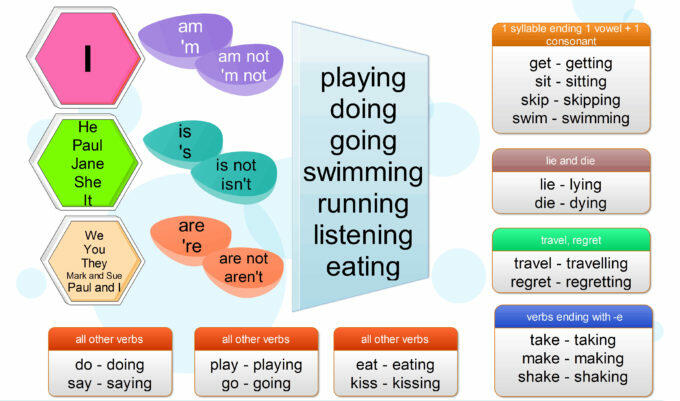 First, we use Present continuous for things that are happening at the moment of speaking. These things usually last for quite a short time and they are not finished when we are talking about them.
I'm working at the moment.
Please call back as we are eating dinner now.
Julie is sleeping.
We can also use this tense for other kinds of temporary situations, even if the action isn't happening at this moment.
John's working in a bar until he finds a job in his field. (He might not be working now.)
I'm reading a really great book.
She's staying with her friend for a week.
Compare this with the present simple, which is used for permanent situations that we feel will continue for a long time.
I work in a school. (I think this is a permanent situation.)
I'm working in a school. (I think this is a temporary situation.)
We can use the present continuous for temporary or new habits (for normal habits that continue for a long time, we use the present simple). We often use this with expressions like 'these days' or 'at the moment'.
He's eating a lot these days.
She's swimming every morning (she didn't use to do this).
You're smoking too much.
Another present continuous use is for habits that are not regular, but that happen very often. In this case we usually use an adverb like 'always', 'forever' or 'constantly'. Often, we use the present continuous in this way to talk about an annoying habit.
You're forever losing your keys!
She's constantly missing the train.
Lucy's always smiling!
Future Uses
5: The next use is for definite future arrangements (with a future time word). In this case we have already made a plan and we are pretty sure that the event will happen in the future.
I'm meeting my father tomorrow.
We're going to the beach at the weekend.
I'm leaving at three.
We can't use this tense (or any other continuous tense) with stative verbs.
You can check this useful video about the difference between Present Simple and Present Continuous: https://www.youtube.com/watch?v=SL3ciyAEcms&t=2s&ab_channel=LearnEnglishwithRebecca%C2%B7engVid
2

23 грудня 2021

Рефлексія від 0 учнів
Сподобався:
0
Так: 0
Ні: 0
Зрозумілий:
0
Так: 0
Ні: 0
Потрібні роз'яснення:
0
Ні: 0
Так: 0