This lesson explains the meanings of some phrasal verbs.
Конструктор уроків
- Всеосвіта›
- Бібліотека уроків›
- Англійська мова›
- Phrasal verbs: Explanatory notes

Урок:
Phrasal verbs: Explanatory notes

20.06.2021
Опис уроку (учням цей опис не показується):
Вміст уроку:
1
2
3
4
Опис, який учні побачать перед початком уроку
This lesson explains the meanings of some phrasal verbs.
1
Phrasal verbs are composed of two words: a main verb and a particle.
There are four different types of phrasal verbs (see pictures below).

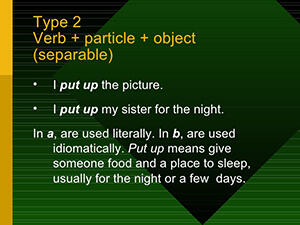
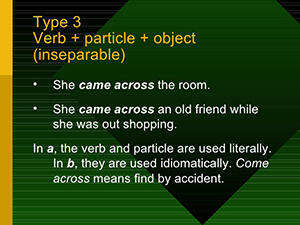

In other sources (e.g. http://www.blairenglish.com), transitive and inseparable phrasal verbs are classified as Type 2 while transitive and separable — as Type 3.
2
Examples
Type 1: come out, grow apart, go up / go down, give in, take off, cut in, die out.
When the sun, moon or stars come out, they appear.
Grow apart (from someone) = to stop having a close relationship with someone over a period of time.
If the price of something, the temperature, etc. goes up, it becomes higher; if they go down, they become lower.
Give in (to someone) = to admit that you have been defeated by someone.
Take off (of an aircraft, etc.) = to leave the ground and begin to fly.
Cut in = to interrupt someone when they are speaking.
Die out = to stop existing.
Type 2: talk out, pick up, put away, cut off, carry over, point out, figure out.
Talk something out = to discuss something carefully and completely in order to make a decision, solve a problem, etc.
Pick somebody up = to go somewhere in your car and collect somebody who is waiting for you.
Put something away = to put something in the place where it is kept because you have finished using it.
Cut something off = to stop the supply of something to somebody; to remove something from something larger by cutting.
Carry something over = to delay something until a later time.
Point out (to somebody) / point something out (to somebody) = to mention something in order to give somebody information about it or make them notice it.
Figure somebody or something out = to think about somebody or something until you understand them or it.
3
Examples
Type 3: stick to, take on, grow into, get over, come across, look through, care for.
Stick to something = to continue doing something despite difficulties.
Take something on = to begin to have a particular quality, appearance, etc.
Grow into something = to gradually develop into a particular type of person or thing over a period of time.
Get over something = to deal with or gain control of something.
Come across someone or something = to meet or find someone or something by chance.
Look through something = to examine or read something quickly.
Care for = to look after someone who is sick, very old, very young, etc.
Type 4: speak up for, fit in with, cut down on, get along / on with, fall back on, put up with, come up against.
Speak up for somebody or something = to support somebody or something, especially by saying good things about him, her, or it.
Fit in (with somebody or something) = to live, work, etc. in an easy and natural way with somebody or something.
Cut down (on something) = to reduce the size, amount or number of something.
Get along / on with somebody = to have a friendly relationship with somebody.
Fall back on somebody or something = to go to somebody for support; to have something to use when you are in difficulty.
Put up with somebody or something = to accept (or continue to accept) an unpleasant situation or experience, or somebody who behaves unpleasantly.
Come up against somebody or something = to be faced with or opposed by somebody or something.
Sources: http://www.bbc.co.uk/worldservice/learningenglish/flatmates/episode33/languagepoint.shtml
https://www.oxfordlearnersdictionaries.com
4
Make 5–6 sentences using phrasal verbs of each type.
.png)
Рефлексія від 3 учнів
Сподобався:
0
Так: 3
Ні: 0
Зрозумілий:
0
Так: 3
Ні: 0
Потрібні роз'яснення:
0
Ні: 3
Так: 0