Мета уроку: вдосконалювати лексичні навички, навички читання та аудіювання, підвищувати загальну екологічну культуру.
Конструктор уроків
- Всеосвіта›
- Бібліотека уроків›
- Англійська мова›
- Natural Disasters

Урок:
Natural Disasters
11.01.2023
Опис уроку (учням цей опис не показується):
Вміст уроку:
1
2
3
4
5
6
Опис, який учні побачать перед початком уроку
Good Luck!
1
Warm-up
Answer the questions:
What is a disaster?
What are some different kinds of disasters?
What kind of disasters are common in our country?
What is the difference between natural disasters and human-made disasters?
.png)
2
Read the description of the following disasters and guess what it is; one choice is extra: blizzard pollution tornado drought epidemic avalanche hailstorms wildfire
A violent and heavy snowstorm is called a … .
… are rain drops that have formed together into ice.
An … is a side of a large snow (or rock) mass down a mountainside. It is one of the major dangers faced in the mountains in winter.
A disease that spreads rapidly among a lot of people in the same area is called an … .
Something that makes the air, rivers or seas dirty is known as … .
A … is defined as a shortage of water and crop failure. It is an abnormally dry period when there is not enough water to support water needs.
A … is an uncontrolled fire burning in wildland areas. Common causes include lightning and drought but they may also be started by human carelessness.
3
Read the text and do the task.
THE CAUSES OF FLOODS
Floods are second only to fire as the most common of all natural disasters. They occur almost everywhere in the world, resulting in widespread damage and even death. Consequently, scientists have long tried to perfect their ability to predict floods. So far, the best that scientists can do is to recognize the potential for flooding in certain conditions. There are a number of conditions, from deep snow on the ground to human error, that cause flooding.
When deep snow melts it creates a large amount of water.Although deep snow alone rarely causes floods, when it occurs together with heavy rain and sudden warmer weather it can lead to serious flooding. If there is a fast snow melt on top of frozen or very wet ground, flooding is more likely to occur than when the ground is not frozen. Frozen ground or ground that is very wet and already saturated with water cannot absorb the additional water created by the melting snow. Melting snow also contributes to high water levels in rivers and streams. Whenever rivers are already at their full capacity of water, heavy rains will result in the rivers overflowing and flooding the surrounding land.
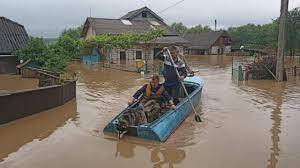 Rivers that are covered in ice can also lead to flooding.When ice begins to melt, the surface of the ice cracks and breaks into large pieces. These pieces of ice move and float down the river. They can form a dam in the river, causing the water behind the dam to rise and flood the land upstream. If the dam breaks suddenly, then the large amount of water held behind the dam can flood the areas downstream too.Broken ice dams are not the only dam problems that can cause flooding. When a large human-made dam breaks or fails to hold the water collected behind it, the results can be devastating. Dams contain such huge amounts of water behind them that when sudden breaks occur, the destructive force of the water is like a great tidal wave. Unleashed dam waters can travel tens of kilometres, cover the ground in metres of mud and debris, and drown and crush every thing and creature in their path.
Although scientists cannot always predict exactly when floods will occur, they do know a great deal about when floods are likely, or probably, going to occur. Deep snow, ice-covered rivers, and weak dams are all strong conditions for potential flooding. Hopefully, this knowledge of why floods happen can help us reduce the damage they cause.
4
Choose the best answer(s) for each question.
1. Which of the following words are natural disasters? (More than one answer may be correct).
a) flood b) earthquake
c) airplane crash d) typhoon
2. Which of the following are included as causes for floods in the reading passage?
a) droughts b) large lakes
c) poorly built roads d) melting snow
3. How does deep snow cause flooding?
a) melting snow causes flooding
b) too much rain causes flooding
c) sudden warm temperatures combined with heavy rains causes flooding
d) freezing water causes flooding
4. A broken human-made dam is compared to what?
a) a tsunami b) a tidal wave
c) a broken ice dam d) overflowing
5. Which of the following best describes how a frozen river can cause a flood.
a) The ice in the river melts too quickly and causes a flood.
b) The ice in the river cracks causing the water to overflow.
c) The ice in the river cracks into pieces that eventually create a dam causing the water to overflow.
d) The water behind the ice dam collects and when the dam breaks, it causes flooding upstream.
6. How far can dam water travel when it is unleashed from a broken dam?
a) less than 10 kilometres
b) tens of kilometres
c) thousands of kilometres
d) tens of thousands of kilometres downstream
7. Why does saturated ground contribute to flooding problems?
a) the ground cannot absorb more moisture
b) the ground is too hard, so the water runs off
c) the ground forms a kind of dam
d) it remains frozen
8. What kinds of problems can floods cause?
a) death
b) widespread damage
c) destruction of plants and animals
d) all of the above
9. What is the most common natural disaster?
a) flood b) fire
c) wind damage d) rain
10. How does melting snow cause problems related to flooding?
a) it makes the rivers run too fast
b) it makes the water too cold
c) it causes pieces of ice to block the river
d) it makes the level of the river rise
5
Choose the best word to complete the following sentences.
combine, dams, devastating, flooding, human-made, pieces, potential, prevent, snow, widespread
CAUSES OF FLOODS
Floods cause 1 __ damage. Unfortunately, there is little we can do to 2 _ flooding in some situations. There are several causes for 3 __ including deep 4_ melt, icy rivers, and broken 5 _ . First, when deep snow melts it creates large amounts of water. When heavy rain and sudden warm temperatures 6 _ with the deep snow, floods can occur. Second, rivers that are covered in ice can cause floods when the ice melts. The ice 7 _ form dams which break and cause flooding. Third, 8 _ dams can break and cause 9 __ damage. The water from these dams can be as powerful as a tidal wave. Our best plan of attack against flooding is to recognize the 10 __ for flooding in certain conditions.
6
Watch the video “Natural Disasters” and choose the correct answer.
What natural disaster was not mentioned in the video?
a) drought b) earthquake c) forest fire d) landslide
Опис, який учні побачать після проходження уроку

Рефлексія від 14 учнів
Сподобався:
0
Так: 12
Ні: 2
Зрозумілий:
0
Так: 12
Ні: 2
Потрібні роз'яснення:
0
Ні: 13
Так: 1