https://test-english.com/explanation/b2/all-conditionals-mixed-conditionals-alternatives-if-inversion/
https://test-english.com/explanation/b2/first-second-third-conditionals/
https://www.grammarly.com/blog/sentences/conditional-sentences/
Конструктор уроків
- Всеосвіта›
- Бібліотека уроків›
- Англійська мова›
- All conditionals

Урок:
All conditionals
15.12.2025
9 Клас, 10 Клас
4
0
261
0
2
2
Залучено ШІ
При створенні цього матеріалу був залучений штучний інтелект.
Вміст уроку:
1
2
3
4
1
 Zero conditional
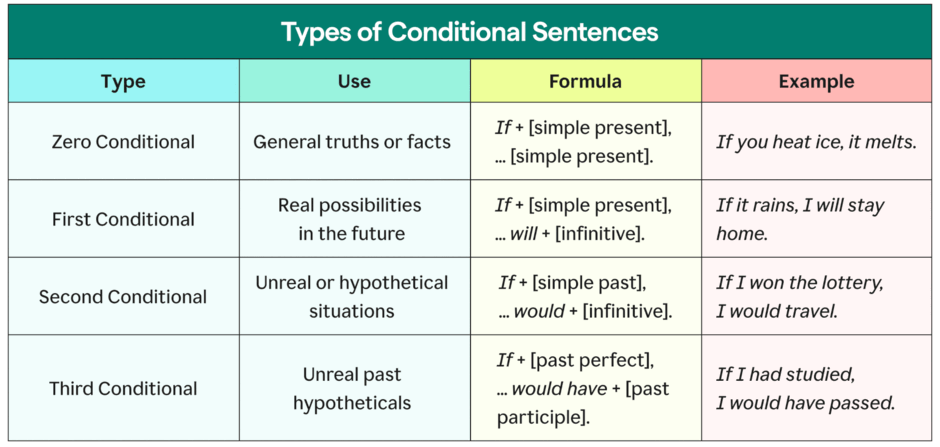
We use the zero conditional to talk about general truths or results that always happen if a condition is present. We are talking in general, not about one particular situation.
If milk smells bad, I don’t drink it.
If water reaches 100 degrees, it boils.
If I’ve drunk, I never drive.
If people are talking all the time, I can’t concentrate.
We can put the main clause at the beginning. Then we don’t use a comma between the two clauses.
I never go to bed late if I have to get up early.
We can usually replace the if in this conditional with when without changing the meaning.
Dogs can attack you when you are scared.
When the weather is bad, people don’t go shopping.
First conditional
The first conditional is used to talk about things that might happen in the future if a condition is present. We don’t know if those things will happen or not, but they are a real possibility.
If you study, you’ll pass.
If he doesn’t call you, tell me immediately.
If you’ve come to class, the exam is going to be easy.
If you help me, I’ll have finished by the end of the month.
We don’t use will in the if clause.
I’ll help you if you need me (NOT
if you will need me)
Unless = if (not)
We can also use unless in conditional sentences to mean if … (not)
I won’t go on holiday unless I save some money. =
= I won’t go on holiday if I don’t save some money.
First vs zero conditional
We use the first conditional to talk about a particular situation, whereas we use the zero conditional to talk about what happens in general.
If you don’t use oil, it tastes awful. (I’m talking about what happens every time.)
If you don’t use oil, it will taste awful. (I’m talking about this particular occasion.)
Second conditional
We use the second conditional to talk about hypothetical or imaginary situations in the present or the future. We can use past simple or past continuous in the if-clause and we can use would, could or might + simple infinitive (do) or continuous infinitive (be doing) in the main clause.
If there was a fire, it would be impossible to escape.
If you weren’t making so much noise, I could concentrate.
I wouldn’t have a car if I lived in the city.
If it weren’t for him, I might not be talking to you right now.
When we use the verb be in the if-clause, we can use either was (more formal) or were (spoken English) after I, he, she or it. But when we are giving advice, we always use if I were you (NOT was).
If he was/were rich, he wouldn’t be living in this house.
If I were you, I’d call him as soon as possible. (NOT was)
As with all conditional types, we use a comma after the if-clause when it goes at the beginning of the sentence, but we don’t use a comma when the if-clause goes at the end.
If you weren’t making so much noise, I could concentrate.
I could concentrate if you weren’t making so much noise.
Third conditional
We use the third conditional to talk about hypothetical or imaginary situations in the past. We can use the past perfect simple or past perfect continuous in the if-clause and we can use would, could or might + the perfect infinitive in the main clause.
If you had come to class more often, you would have passed the test.
I wouldn’t have been late if I hadn’t overslept.
He could have died if he hadn’t been wearing a helmet.
If the jacket had been a bit cheaper, I might have bought it.
Mixed conditionals
We use mixed conditionals to mix talking about the present and the past in the same sentence. The mixed conditional is a combination of the second and the third conditional:
➟ We can use past simple or continuous in the if-clause (to refer to the present or future) and would/ should/ might have + past participle in the main clause (to refer to the past).
➟ We can also use past perfect in the if-clause (to refer to the past) and would/ should/ might + infinitive (to refer to the present).
If I didn’t have (second conditional) so much work, I would have gone (third conditional) to the party last night.
If I spoke (second conditional) German, I would have understood (third conditional) them.
If I had won (third conditional) the lottery, I would be (second conditional) rich.
If I hadn’t dropped (third conditional) school, I could have (second conditional) a better job now.
Alternatives to if in conditional sentences
As long as / provided (that) / providing (that) / on condition (that) / only if
We can use the expressions as long as, provided/ providing (that), on condition (that), or only if instead of if when we want to emphasise the condition that needs to be present so that something can happen or be done.
I’ll tell you what really happened as long as you keep the secret.
I’ll lend you the money provided (that) you pay me back next month.
They will speak to the press on condition (that) they remain anonymous sources.
We will invest the money, but only if you can prove that it’s a safe investment.
Whether or not
We use whether or not when there are two alternatives, and we want to say that something will happen or will be true in any of those two alternatives. Compare:
I’ll help him if he needs me. (=I will help him only if he needs me.)
I’ll help him whether or not he needs me. (I will help him if he needs me, and I will help him if he doesn’t need me, too.)
Even if
We also use even if with a similar meaning to ‘whether or not’. It is used to emphasise that something will still be true or will happen if another thing happens.
Even if you apologise, he’ll never forgive you. (=Whether or not you apologise, he’ll never forgive you.)
Suppose/supposing
We normally use suppose or supposing at the beginning of a sentence to make someone imagine a situation. It means ‘what would happen if’, or simply ‘if’ (imagining a situation).
Supposing I got a job, I wouldn’t be able to travel with you next summer.
Suppose she doesn’t believe you, what would you do then?
Inversion in conditional sentences
Should you find
In first conditional sentences, it’s possible to use should at the beginning of the sentence instead of if. This form is formal, and it’s common to use an imperative form in the main clause.
Should you find the answer, please let me know as soon as possible. (=If you find the answer)
Should you change your mind, you know where to contact us. (=If you change your mind)
Had we arrived
In third conditional sentences, we can invert the auxiliary verb had and leave if out. Had we arrived = If we had arrived.
Had we arrived earlier, we could have prevented the incident.
Had they looked further into the data, they might have realised there was a mistake.
Were we to announce
We can also find cases of inversion with this structure: were + subject + to. + infinitive. It is used to talk about future improbable events (like the second conditional).
Were we to announce the truth, we would receive a lot of criticism. (=If we announced …)
Were they to buy a new house, they would need to sell the old one first. (=If they bought …)
Negative forms: should I not, had we not, were we not
When should, had or were are negative, contracted forms are not used, and not is used after the subject.
Shouldn’t you wish to retake the test, you must let us know before the end of June.

Should you not wish to retake the test, you must let us know before the end of June.

Hadn’t you refused my invitation, we would have had the most incredible time in our lives.
Had you not refused my invitation, we would have had the most incredible time in our lives.
Weren’t you my brother, I would call the police.
Were you not my brother, I would call the police.
Check out this video for more information (and some laughs ;) )
2
Complete exercises above, to check your knowledge:
Write the results and what was the hardest parts of each exercise below:
.png)
3
1 з 1 бала
Write 2 sentences for every conditional.
Only word-documents!
Write 10 in total sentences and explain (in writing), why did you put this type of conditionals in sentence.
.png)
4

Опис, який учні побачать після проходження уроку
Good job! Now you know more about conditionals and can use them in your everyday life!

Рефлексія від 0 учнів
Сподобався:
0
Так: 0
Ні: 0
Зрозумілий:
0
Так: 0
Ні: 0
Потрібні роз'яснення:
0
Ні: 0
Так: 0