
olgaponomareva441@gmail.com домашнє завдання надсилайте на мою пошту.
13.03.2020.
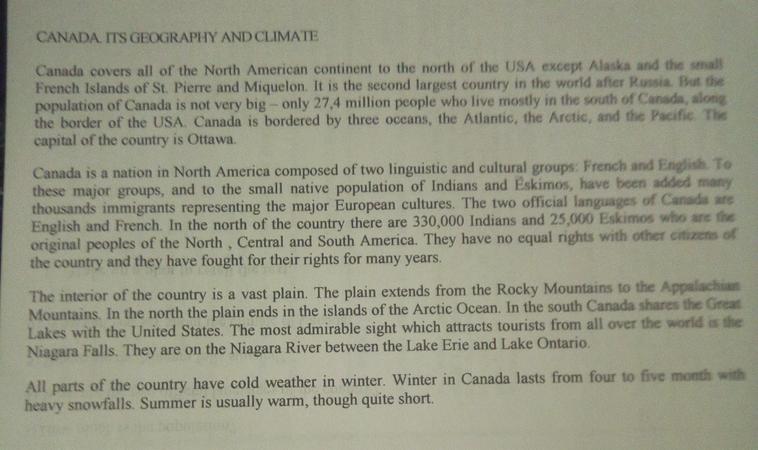
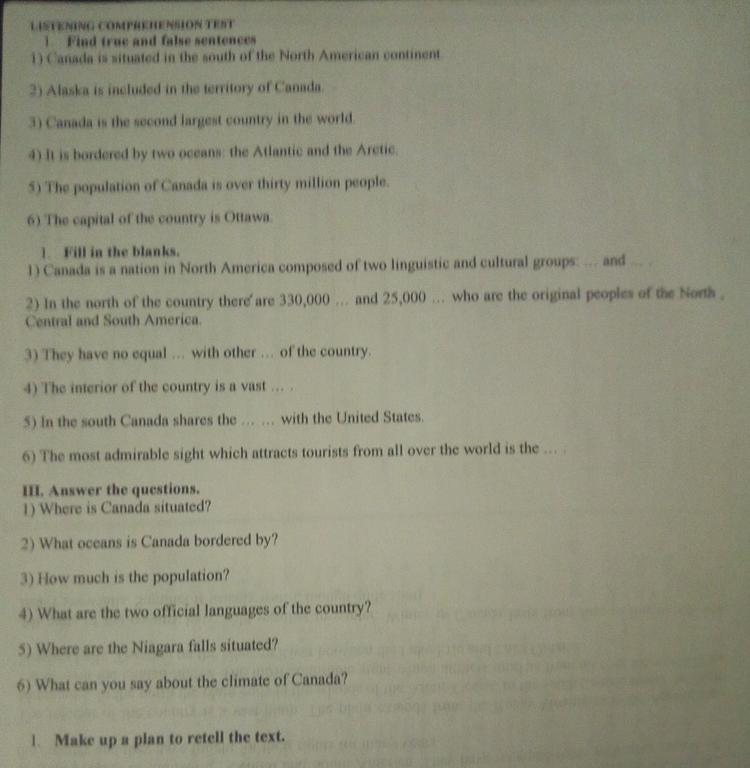
31-17 Англ.\мова Текст «Канада» читати, перекладати текст, виконати завдання
18.03.2020р.
31-17 англ\мова
THE READING / TAPESCRIPT
Canada Day is on July the 1st every year. Canadians all around the world celebrate the day when their nation became a country on July 1, 1867. Today, it is a federal national holiday. Many Canadians call it “Canada’s birthday”. Canada Day recognizes the British North America Act of 1867. This united Canada as a single country made up of four provinces. The holiday was not widely celebrated until the early 20th century and was actually called Dominion Day until 1982. The first official celebrations took place in 1917, which was the golden anniversary of nationhood. Canada's centennial in 1967 marked the start of Canada Day being celebrated with real pride. Dominion Day officially changed to Canada Day on October 27, 1982. Canada Day is a time for Canadians to party. There are festivals and events all across the country. Canadian communities around the world also join in the fun. Most of the celebrations are outdoors. They include parades, fireworks displays and music concerts. There are also citizenship ceremonies for people becoming new citizens. Canada Day is quite a colourful occasion and it celebrates the nation’s multi-ethnicity. Canada is a very cosmopolitan country, so you can expect to see flags from all around the world being waved as well as the Canadian flag. Not every Canadian is happy on this day. Many people in the French-speaking province of Quebec see no reason to celebrate. They want their own independence from Canada.
PHRASE MATCH
Match the following phrases from the article.
Paragraph 1
1. Canadians all around the a. national holiday
2 Today, it is a federal b. widely celebrated
3. This united Canada c. pride
4. The holiday was not d. as a single country
5. the golden anniversary e. world celebrate
6. celebrated with real f. of nationhood
Paragraph 2
1. Canada Day is a time for a. join in the fun
2 communities around the world also b. Canadians to party
3. fireworks c. cosmopolitan country
4. ceremonies for people d. from Canada
5. Canada is a very e. becoming new citizens
6. They want their own independence f. displays
Завдання групи 31-17 англ\мова 18.03.2020р.
MULTIPLE CHOICE
Canada Day is on July the 1st (1) ____ year. Canadians all around the world celebrate the day when their nation became a country on July 1, 1867. Today, it is a federal national holiday. Many Canadians (2) ____ it “Canada’s birthday”. Canada Day recognizes the British North America Act of 1867. This united Canada as a single country made (3) ____ of four provinces. The holiday was not widely celebrated until the (4) ____ 20th century and was actually called Dominion Day until 1982. The first official celebrations took place in 1917, which was the (5) ____ anniversary of nationhood. Canada's centennial in 1967 marked the start of Canada Day being celebrated with real (6) ____. Dominion Day officially changed to Canada Day on October 27, 1982. Canada Day is a time for Canadians to party. There are festivals and events all (7) ____ the country. Canadian communities around the world also (8) ____ in the fun. Most of the celebrations are outdoors. They include parades, fireworks displays and music concerts. There are also citizenship ceremonies (9) ____ people becoming new citizens. Canada Day is quite a colourful occasion and it celebrates the (10) ____ multi-ethnicity. Canada is a very cosmopolitan country, so you can expect to see flags from all around the world being waved as (11) ____ as the Canadian flag. Not every Canadian is happy on this day. Many people in the French-speaking province of Quebec see no reason to celebrate. They want their own independence (12) ____ Canada. Put the correct words from this table into the article.
1. (a) all (b) every (c) whole (d) ever
2. (a) calls (b) calling (c) call (d) caller
3. (a) up (b) down (c) at (d) with
4. (a) fast (b) soon (c) start (d) early
5. (a) golden (b) gold (c) goldish (d) golder
6. (a) proud (b) pride (c) proudest (d) proudly
7. (a) across (b) cross (c) crossing (d) crossover
8. (a) joining (b) joint (c) join (d) joins
9. (a) of (b) four (c) for (d) far
10. (a) nations (b) nations’ (c) nation (d) nation’s
11. (a) good (b) well (c) better (d) fine
12. (a) for (b) by (c) to (d) from
Група 31-17 25.03.2020.
Education in Canada
The school system of Canada is very much like the one in the USA, but there are certain differences.
Education in Canada is general and compulsory for children from 6 to 16 years old, and in some provinces — to 14.
It is within the competence of the local authorities, and therefore it may differ from province to province.
For example, Ньюфаундленда has an 11-grade system.
Some other provinces have 12-grade systems, and Ontario has even a 13-grade system.
Grades 1-6 are usually elementary schools, and grades 7-12 are secondary schools.
In some provinces there is a kindergarten year before the first grade.
Elementary education is general and basic, but in the junior high school years the students can select some courses themselves.
Most secondary schools provide programmes for all types of students.
Some of them prepare students for continuing their studies at the university.
Vocational schools are separate institutions for those who will not continue their education after secondary schools.
There also exist some commercial high schools.
Some provinces have private and kindergartens nursery schools for children of pre-elementary age.
There also exist Roman Catholic schools and private schools in some provinces.
In provinces most private schools receive some form of public support.
Admission to the university in Canada is after high school with specific courses.
Getting a degree in law, medicine, dentistry or engineering usually takes 3-4 years of studying.
University tuition fees vary among different provinces.
All provinces also have public non-university institutions.
They are colleges regional, institutes of technology institutes of applied arts, colleges of agricultural technology and others.
Criteria for admission to these institutions are less strict.
Questions: Відповідати письмово на запитання.
1. What do you know about the school system of Canada?
2. Is education in Canada general and compulsory for children?
3. Can the students select some courses in the junior high school years?
4. What does the term “vocational schools” mean?
5. What kind of schools are there in Canada?
6. What grade-systems have some other provinces?
7. What public non-university institutions are there?
8. How many years takes to get a degree in law, medicine, dentistry or engineering?
Дивитись відео про освіту Канади за посиланням https://fakty.com.ua/ua/videos/shkilna-osvita-u-kanadi-4-uroky-i-zhodnyh-domashnih-zavdan/
20.03.2020. група 31-17
Political System In Canada
Canada is an independent federal parliamentary state. The Queen of Great Britain, Elizabeth II, is the official head of the state, but the Governor General acts as her representative.Canada combines the American federal form of government with the British cabinet system.
As a federation, Canada is made up of ten provinces and two territories. Canadian central government in Ottawa represents all the peoples of Canada. Each province has its own government and parliament.
Parliament of Canada consists of two houses, the Upper House called the Senate, and the Lower House called the House of Commons. The Senate has 104 members. Senators are appointed by the Governor General on the recommendation of the Prime Minister. The Senate has less power than the House of Commons. Members of the House of Commons are elected for a term of five years.The cabinet system of Canada unites the legislative and the executive branches. The Prime Minister and the Cabinet are usually members of the House of Commons, which is the highest authority in the government. The Cabinet consists of 20 or more ministers, chosen by the Prime Minister from leaders of the majority party in the House of Commons.
Today most of the Governor General’s powers have disappeared and he follows the directions of the Cabinet.
The two leading political parties in Canada are the Progressive Conservative Party and the Liberal Party. The New Democratic Party is also rather influential.
The Constitution of the country was only adopted in 1982.
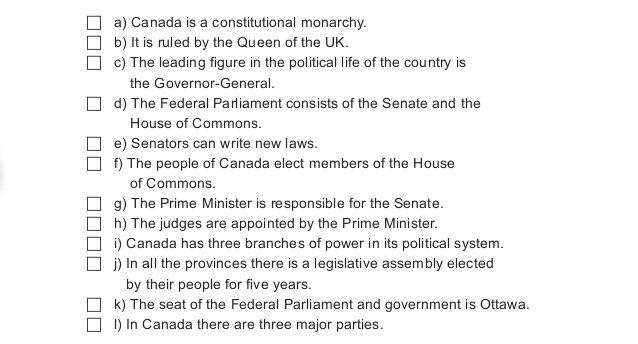
Визначити true or false
.
27.03.2020 група 31-17
Natural Resources of Canada
Canada is the second largest country in the world, located on the continent of North America. Its history as a state begins in 1534, when it was a French colony. Now Canada is formally subordinate to the Queen of Great Britain, and in fact - to the appointed Governor General. The official languages are French and English. Due to its large territory, different climatic zones and relief types, Canada has a mass of various natural resources. Perhaps in this area it can be called one of the world leaders.
Water resources
Canada is surrounded by three oceans and is known for the huge number of fresh lakes in the country. Also on its territory there are about ten large rivers and countless small ones. In total, Canada has approximately 15% of the world's fresh water reserves. A significant amount of it is spent on hydropower generation (currently there are 4 operating hydroelectric power plants in the country), but with a margin it is also enough for use in agriculture - for example, irrigation of territories. It is poorly used only in some northern and central territories - due to their weak population and the disadvantage of such projects.
Land resources
Canada is a huge country, with an area of about 10 million km². A little more than seven percent of the territory is given for agriculture. The figure may seem small, but this is only due to the low population density and a large number of undeveloped territories. In addition, the climate is different in different parts of the country, which introduces serious diversity into agriculture - for example, dairy products are produced in Quebec, gardening is popular in Ontario, and crops are grown in the western steppes. There is also a large number of vacant land suitable for construction, but it is not being conducted very actively due to the small number of population and large territory.
Forest resources
A little more than a third of the state’s land area is covered by forests, mainly Taiga. A huge number of trees and shrubs grow there - both native species and common around the world. Slightly more than 10% of the total area is officially protected from exploitation, but forests are cut down rather slowly, although Canada is involved in wood processing. This is partly due to the fact that approximately one sixth of the forests have no ground access at all.
Mineral resources Canada rightfully belongs to one of the first places in the world in terms of the amount of mineral resources. It takes 5th place in coal reserves, it is also known about large deposits of oil and gas, although at the moment their full-scale production is not conducted. Also in the country there are a lot of uranium and other ores, as well as other non-ferrous metals
Alternative energy sources Since 2007, Canada has been actively developing and preparing for implementation plans and projects for the use of renewable resources - solar, wind and geothermal energy. They should provide the country with independence from imported fuel and its prices, and also will not have a detrimental effect on the environment.
Complete the sentences. Доповнити речення.
- Its history as a state …. in 1534, when it was a …. colony.
2. Canada is …. by three oceans and is known for the ….number of …… in the country.
3. …. total, Canada has approximately …. of the world's fresh water reserves.
4…… little more than …. …… of the territory is given …..agriculture.
5. The figure …. …… small, but this is only due to the low …….density and a large number of …. …….. .
6. A little more than … ……of the state’s land area is covered by forests, mainly Taiga.
7. Slightly ….. ….. ….. of the total area is ……protected from ……., but forests are cut down rather slowly, although Canada is ……. in wood processing.
Translate into Ukrainian
the huge number of fresh lakes
countless
approximately
fresh water reserves
significant amount
different climatic zone
trees and shrubs
detrimental effect
native species and common
protect from exploitation
wood processing
mineral resources
coal reserves
deposits of oil and gas
uranium and other ores
non-ferrous metals
implementation plans
renewable resources
huge
Alternative energy sources
Make the right order of the sentences following the text.
Встановити відповідний порядок речень за текстом
____ Canada has been actively developing and preparing for implementation plans and projects for the use of renewable resources - solar, wind and geothermal energy.
___ Canada is the second largest country in the world, located on the continent of North America.
A little more than a third of the state’s land area is covered by forests, mainly Taiga.
__In addition, the climate is different in different parts of the country, which introduces serious diversity into agriculture - for example, dairy products are produced in Quebec, gardening is popular in Ontario, and crops are grown in the western steppes.
___Due to its large territory, different climatic zones and relief types, Canada has a mass of various natural resources.
___It takes 5th place in coal reserves, it is also known about large deposits of oil and gas, although at the moment their full-scale production is not conducted.
___Slightly more than 10% of the total area is officially protected from exploitation, but forests are cut down rather slowly, although Canada is involved in wood processing.
___A little more than seven percent of the territory is given for agriculture.
___Its history as a state begins in 1534, when it was a French colony.
___In total, Canada has approximately 15% of the world's fresh water reserves. A significant amount of it is spent on hydropower generation (currently there are 4 operating hydroelectric power plants in the country), but with a margin it is also enough for use in agriculture - for example, irrigation of territories.
Контроль письма група 31-17 01.04.
WRITING (THE SECOND TERM)
Variant 1
- Make up three special questions to the text below.
An important part of youth culture today is modern movie theatres. With the advent of modem technologies cinema becomes popular again. Now modern movie theatres are equipped with all kinds of technical innovations like wide-screen and cinemascope, 3-D, Cinerama, Dolby surround sound, etc. Cinemagoers, especially young people, very quickly get accustomed to these technological advances and now they are used to going to movie theatres. It's part of their day-to-day life.
1) ___________ .
2) ____________
3)_____________
2. Read the text below. Fill in each gap (1—4) with the appropriate word.
Smog
The word 1) _______ is a combination of the words smoke and fog. In many areas around the 2)___________, smog has reached extraordinary levels. Some governments have quickly reacted with severe measures in response to the problem.
Modern Los Angeles suffers severely from smog, as London did in the 19th 3) ___________These two areas released certain chemicals into the 4) ___________ and created a foggy atmosphere. In London, where fog levels have now fallen far below those of years ago, people were often unable to see their hands and sometimes could not walk around. It took a long time for governments to act and control smog. The
Clean Air Act of 1970 in the United 5)___________ limited the legal smog levels. The Environmental Protection Agency now measures levels of smog and regulates smog producers.
- Put the verb in brackets into the correct form Infinitive or Gerund.
- I really enjoy ______________(go) to the cinema.
- It’s really late. Mike should _____________(be) home already.
- He has refused _____________(accept) his father’s decision.
- My cousin really dislikes _____________(get) up early.
- Jack is planning _____________(go) on holiday next week.
- I don’t mind __________(wait) for a few minutes.
- Write what international organizations the following abbreviations stand for.
-
UN —
EC —
EP
31-17 Англійська мова Підготувати тему за темою «Canadian Foreign Policy»
08.04.2020.
31-17 Англійська мова Виконати контроль з читання. Виконати контроль з аудіювання
.Контроль аудіювання.
Test (Виконання контрольної роботи).
LISTENING COMPREHENSION (THE SECOND TERM)
Task 1
He Was Not Sure Himself A rich American went to Paris and bought a picture by a modern artist. He had paid a lot of money for the picture, so he thought the picture was very good. He came to the hotel where he stayed and wanted to hang the picture. To his surprise he could not tell what was the top and what was the bottom. So he thought of a plan and invited the, artist to dinner. The artist looked at the picture many times. He put on his glasses and approached the picture to look at it more closely. And at last when they began to drink coffee, the artist told the American that the picture was upside down. The American was surprised and wondered why the artist had not told it to him at once. The artist had to admit that he himself was not sure about it at first. So the rich American left the picture on the wall as if was. He thought that nobody noticed that it was upside down.
LISTENING COMPREHENSION (THE SECOND TERM)
Variant 1
1. Listen to the story and mark the following statements as true or false.
1) The text describes modern French art.________
2) The person who bought the picture by a modern artist was from the USA.______
3) The picture was a water colour portrait of the American's wife.__________
4) The picture was rather cheap but nice.________ 5) The American invited the artist to dinner in order to find out what was the name of the picture._____
6) The artist noticed at once that the picture was upside down._____
7) The rich American turned the picture over so that nobody would notice that it was upside down._____
2. Listen to the facts about famous political figures and write down the missing words.
1. During the reign of Elizabeth I, there was___________ a put on men's beards.
2. The national flag of Italy was ___________ by Napoleon Bonaparte.
3. While at Harvard University, Edward Kennedy was suspended for ________ on a Spanish exam.
4. The house where Jefferson wrote the ___________ of Independence was replaced with a hamburger stand.
5. Ernest Bevin, Minister of __________ during World War H, left school at the _______ of eleven.
Контроль читання.
READING (THE SECOND TERM)
Variant 2
1. Read the text below. For questions (1—5) choose the correct answer (A, B, C or D).
British Youth
The new teen generation is richer, better educated and healthier than any other in history. In many ways, these teens are uniquely privileged. They have grown up in a period of nonstop prosperity. Cable and the Internet have given them access to a large amount of information. Most expect to go to colleges and universities, and girls, in particular, have equal opportunities with boys. But this is a positive image of British teenagers. However, in survey after survey, many kids say they feel increasingly alone and alienated, unable to connect with their parents, teachers and sometimes even classmates. In fact, of all the issues that trouble the young loneliness ranks at the top of the list. A university sociologist Barbara Schneider has been studying 7,000 teenagers for five years and has found they spend an average of 3 hours alone every day. Teenagers may claim they want privacy, but they also want and need attention — and they do not usually get it. Even the best most caring parents can't protect their teenagers from all these problems, but involved parents can make an enormous difference. Children do listen. So parents should share with their children what they really believe in, what they really think is important. These basic moral values are more important than math skill or any school exams. Parents have to work harder to get their points across. The kids can't wait.
1) What is the main idea of this text?
A. The modern teenagers are happier than the kids of the past.
B. The teenage period is mostly difficult for parents.
C. Parents can help their children to overcome teenage difficulties.
D. All the teenagers have no problems.
2) What do many kids say they feel like?
A. Independent. B. Happy. C. Self-confident. D. Lonely.
3) What do teenagers really need? A. Privacy as well as attention.
B. Privacy but not attention.
C. Attention but not privacy.
D. » Neither attention nor privacy.
4) What should parents share with their children according to the text?
A. Money. B. Beliefs and ideas. C. Problems. D. Everything.
5) What does an involved parent mean?
A. Indifferent. B. Kind. C. Caring. D. Strict.
2. Read the text below. For questions (1—7) choose the correct answer (A, B, C or D).
Ukraine and the Council of Europe
The Council of Europe (CE) was 1) ____________ in 1949 with 10 founding members; there are now almost 50 member states. The 2) ____________has its headquarters in Strasbourg, France. Its purpose is to achieve European unity and facilitate economic and social progress. It is concerned with issues such as human 3) _________, education and cultural projects, public health, protection of the environment, etc. 4)_____________participation in the Council of Europe (CE) is evidence of devotion to her European choice and to the commonly recognized principles of pluralistic democracy, the rule of law, and commitment to basic human rights and 5)____________. Ukraine actively participates in helping the Council of Europe address social problems, in particular, in 6) ________of the rights of national minorities, combatting xenophobia and racial intolerance, environmental protection, the maintenance of biological ethics, as well as controlling AIDS and drug abuse. Ukraine is a 7) _____________ of a series of conventions by the Council of Europe, in particular, the European Cultural Convention, European Framework Convention on Cross-Border Cooperation among territorial communities or authorities, European Convention on Information about Foreign Legislation, six crime control Conventions, and Framework Convention on Protecting National Minorities.
A B C D
1 found crafted start created
2 treaty organization company officials
3 rights lefts duties wrongs
4 Ukraine Ukraine's Ukraines' Ukraines
5 labors liberties libertarian leagues
6 support demand maintain defend
7 participate participation participating participant
15.04 31-17 Англійська мова Виконати контроль з говоріння. Підготувати тему для усного мовлення про Україну.
17.04 31-17 Англійська мова Повторити вивчений матеріал. Виконати завдання за текстом, читати та перекладати текст.
The political system of Ukraine
Ukraine is a sovereign state whose independence was declared on August 24, 1991. The country has a democratic political system which means that its executive branch is headed by the president with strong powers, and its legislative branch is represented by a national parliament.
The president who is elected to a five-year term is the commander-in-chief of the military forces and can issue orders, called edicts, without the approval of the parliament.
Ukraine's parliament, called Verkhovna Rada (the Supreme Council), is the nation's law-making body. It has one chamber consisting of 450 members who are elected by voters at general elections to a five-year term. Every citizen of Ukraine over 18 has the right to vote in the elections.
Judicial power in Ukraine is represented by the Supreme Court and the Constitutional Court.
The president is assisted by a Cabinet of Ministers whose responsibilities lie in the areas of foreign affairs, home policy, economy, science and technology, industry, law and humanitarian matters. The Cabinet is headed by the Prime Minister who is appointed by the president and approved by the majority of the Parliament.
In other words, it is possible to say that state power in Ukraine is based on the division of authority into legislative, executive and judicial branches, and Ukraine can be called a country with a parliamentary-presidential form of government.
Administratively Ukraine is divided into 24 regions, called «oblasty». Crimea, which is also part of our country, has a special status of an autonomous, self-governing republic. Each region has its local governs bodies which are responsible to the Cabinet of Ministers and the President.
There are a variety of political parties in Ukraine; they currently number more than 60. The most influential are the Social-Democratic Party of Ukraine (united), the Rukh, the People's Democratic Party (NDP) and the Socialist party. The President of Ukraine does not belong to any of the parties.
The main trend of foreign policy in Ukraine is to live in peace with the rest of the world community, to co-operate with other countries and participate in European and world structures through membership in the United Nations Organisation and other international political, economic and cultural organisations.
- Match the following English terms with their Ukrainian equivalents:
|
1) legislative branch |
1) Верховний Суд |
|
2) executive branch |
2) загальні вибори |
|
3) judiciary branch |
3) гарантії |
|
4) commander-in-chief |
4) законодавча влада |
|
5) Supreme Court |
5) законотворчий орган |
|
6) Supreme Council |
6) головнокомандувач |
|
7) general election |
7) Палата Представників |
|
8) guarantees |
8) законопроект |
|
9) voters |
9) Верховна Рада |
|
10) lawmaking body |
10) виконавча влада |
|
11) bills |
11) судова влада |
|
12) House of Representatives |
12) виборці |
- Decide which is the odd word in each group and explain why. Bear in mind that more that one answer may be possible.
|
1) |
legislative |
democratic |
judiciary |
executive |
|
2) |
court |
law |
bills |
judge |
|
3) |
senator |
voter |
representative |
member of parliament |
|
4) |
Conservative |
Labour |
Democratic |
Liberal |
- Sort out the political terms given in the box into the corresponding columns of the table according to the words with which they can go with:
|
national |
human rights |
demonstration |
political |
reform |
|
situation |
educational |
point of view |
summit |
big |
|
country's |
Ukrainian |
growth |
planning |
career |
|
position |
important |
environmental |
party |
key |
|
local |
recession |
major |
system |
|
politics/policy |
economic |
issue |
political |
Note:Policy- is a set of ideas or plans that is used as a basis for making decisions, especially in politics, economics or business.Politics- are the actions or activities which people use to achieve power in a country, society or organisation.
4 Complete the gaps with one of the words given in the box in Activity 3. The first sentence is done for you:
1. The key issue in the next election will be unemployment.
2. The worsening situation in the southern regions of the country means that many people will lose their jobs.
3. The 1950s saw a period of growth in the UK.
4. The Prime Minister of that country left teaching to pursue a _______ career.
5. The President discussed the _______ of human rights during his visit to Geneva.
6. Many young people nowadays are not interested in _______.
7. The latest book of this writer who is the leader of the Green Party is dealing with issues.
8. The former president's economic _____ put a lot of people out of work.
9. Unemployment and crimes were the_______ issues in the election campaign.
10. Even when she studied at university, Margaret Thatcher was deeply involved in local .
5 Supply the missing members of these words families. Check your answers with the dictionary. The first word is done for you:
|
1) economy - economic, economics, economy, economist, economically, to economize. |
|||
|
2) to govern |
7) to qualify |
12) to support |
17) campaign |
|
3) to elect |
8) bureaucrat |
13) to contribute |
18) law |
|
4) to employ |
9) to corrupt |
14) power |
19) to solve |
|
5) to inflate |
10) democrat |
15) industry |
20) politics |
|
6) to educate |
11) nature |
16) environment |