
Екологія- складна тема для сприйняття студентами, проте можна їх зацікавити, розробивши інтерактивний урок, використовуючи різні сучасні методи навчання!
Тема: The ecological problems of the planet. How to cope with them?
Мета:
Активізувати вживання ЛО з теми;
формувати навички роботи в групах;
розвивати увагу, пам'ять, швидку мовленнєву реакцію;
поглибити знання учнів про екологічні проблеми нашої планети, розширити уявлення учнів про природне середовище, про значення екологічних чинників для формування, збереження здоров’я,
виховувати екологічну культуру, естетичні почуття, бажання бути турботливими господарями довкілля.
Обладнання: дошка ,фотографії, проектор, ноутбук, картки з завданнями, виставка виробів з вторинної сировини
Procedure of the lesson
(Хід уроку)
SLIDE 1(sounds of nature)
I. Greeting
SLIDE 2
T: Good morning! Birds greet a new day with the first rays of the sun, crystal drops of dew ring on grass. Everything is filled with heavy flavor of flowers. I have such associations while listening to this melody. But everything can disappear due to our activity.
So today we shall speak about environmental problems of our planet, see into their causes, consequences and propose the ways to cope with such problems.
Teacher: I`d like you to fill in a self-assessment card at the end of the lesson. SLIDE 3
Skills | Points (0-3) |
1. I can name ecological problems | |
2. I can use the conditionals in English easily | |
3. I can communicate on the topic using vocabulary | |
4. I can work in group | |
5. I know solutions for ecological problems | |
6. I`ve got good listening skills | |
Total |
|
Results:
18-13 – a very good result
12-7 – rather well 6-0 – not good
II. Warming up.
SLIDE 4
Т:Now read the quotations on the screen :
The nation that destroys its soil, destroys itself" (Franklin Roosevelt.)
"Mother planet is showing us the red warning light — be careful — she is saying. To take care of the planet is to take care of your own house." (The Dalai Lama)
"Look after your planet, it's the only one we have." (Prince Philip of Britain, President of the WWF (World Wildlife Fund).
Do you agree with it? What is the main message of these words?
Т:We usually work in groups and today is not an exсeption . We are going to investigate the main environmental problems and answer the problem question
“ How to make our environment healthier.”
III. Revision of the vocabulary
T: Now we are going to revise the vocabulary. Students are given handouts. Group 1-“Eco-Club” has to do a crossword and find 7 words connected with the topic
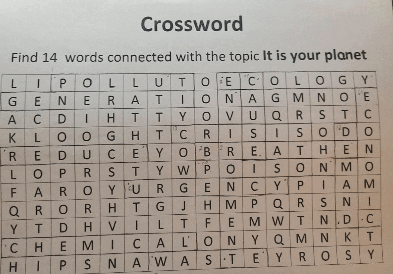
Group 2 – “Eco-Friends” has to do a crossword and find 14 words connected with the topic
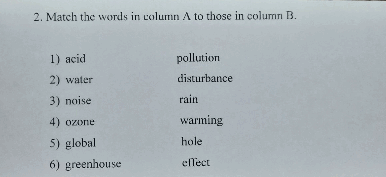
Group3- “Planet Savers” has to match the words combinations
Group 4 has toguess the description of the natural hazards.
1.People had nothing to eat and many people died_______(Famine)
2.There were _______in the South of England. The water 1 meters high.(Floods)
3.There was a terrible______. Many houses and shops burned.(Fire)
4.There was a huge______in Iceland and planes couldn’t fly because of the cloud.(Volcano eruption)
5. ______ is a problem in many countries where there isn’t much rain. The longest was in Atacama desert in Chile.(Drought)
6. ______ is a slide of large snow mass down a mountainside.It is one of the major dangers faces in the mountains in winter.(Avalanche)
T:Leader of the group should answer.
IV. Speaking
T: Now drawing of the mind- map “Man and nature”
T: Group 1 is given a mind-map and a large group of words. Your task is to find familiar words and translate them.
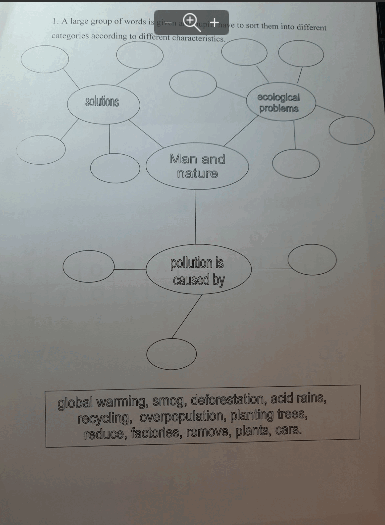
Group 2 is given a mind-map and a large group of words. Your task is to sort words into different categories according to different characteristics
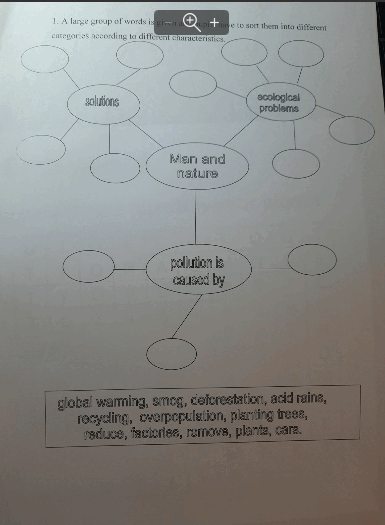
Group 3 is given a mind-map. Your task is to fill in the mind-map
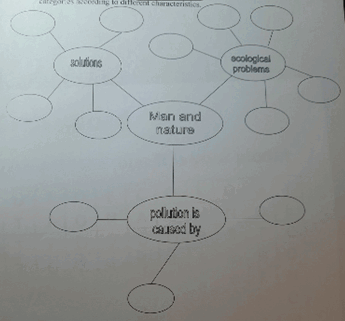
Group 4 has to draw a mind- map.
T:You have minutes for your work
T: Now leader of each group presents the result of your work.
T: Every ecological problem has its cause. So now, look at the photos of ecological problems that you see here, choose the photo.
Group 1,2 choose the picture and name the problem.
Group 3 choose the picture, name and specify the reason for their appearance, for example: in the photo we can see a flood. The cause of it – the deforestation.
Group 4 choose the picture, name, specify the reason for their appearance and suggest the solution. The members of the group presents their team work.
SLIDE 6
Т:Even though you are children you can`t do much about pollution or energy waste, there are a lot of ways in which you can help to save the Earth. One way is to remember three Rs: reduce, recycle and reuse. Now we shall speak how we can reuse some things. You see a packet full of rubbish here choose one object and say how you can reuse it.
Please, tell us how can you reuse this object? Let’s start from the Group-Eco club.
Group 1
The life of a carton milk or juice
You can build a bird feeder out of it.
Group 2
The lives of the plastic bottles.
1.You can keep some seeds or metal things (keys, pins etc.) in it.
2.You can make some plastic decorations for your garden.
Group 3
The lives of glass bottles and old books.
1. A vase for flowers after decoration.
2. You can put coins and have a piggy bank.
3. You can put flowers into the vase made of the book.
The life of a jar
A glass for pencils and brushes;
SLIDE 7
Group 4
The lives of a candy paper box
Keep money in it.
Make a cover for a book.
Cut it and use it as a table mat.
Make a card.
Cut out a mask.
Relieve tension if you're nervous by tearing the box in parts.
Make a beautiful frame.
Cut book-marks.
Make Christmas decorations.
Write on it.
Put photos in it.
The life of a used sheet of paper
Use it again and print. That is why today all tasks are printed out on the used paper.
VII. Physical activity
T: You are a little bit tired so let’s have some rest. Please, do what I say:
- If you don't pick big bunches of wildflowers, clap your hands above your head.
- If you never leave litter in the forest, stomp your feet.
- If you don't break tree branches, jump up and down.
- If you plant trees, flowers and take care of them, raise your hand.
- If you like flowers, smile.
- If a bee or bumblebee has flown into your room and you are trying to get it out, wave your hands.
- If you picked up a stray kitten or dog, stretch your arms forward.
- If your heart hurts when you see a mutilated ['mju:tileit] tree, a cut down fir [fɜ:], a polluted river, put your hand on your heart.
- If you are convinced that everyone should take care of nature, then stretch to your neighbours and take their hand.
- Let's hold hands together like this, and we will be united in saving Mother Nature
VI. Listening
SLIDE 8
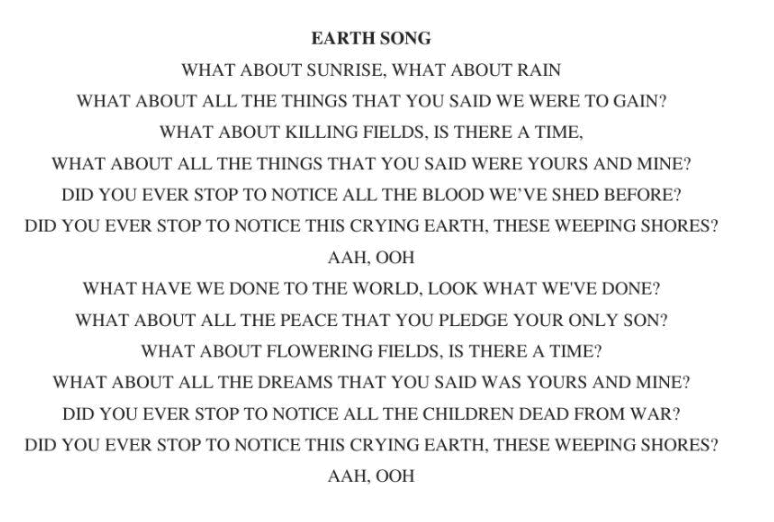
Т:Now we are going to watch the video and listen to the“ Earth Song” by Michael Jackson. But before you watch answer the questions.
What damage was made to the Earth by humans?
Why is it necessary to increase our knowledge of environmental needs?
T: The video shows 3 distinct places (continents) on the planet with a different crisis. You need to (Group1) underline the words you heard in the song.
You (Group 2) have to write the continent mentioned in the song and show it 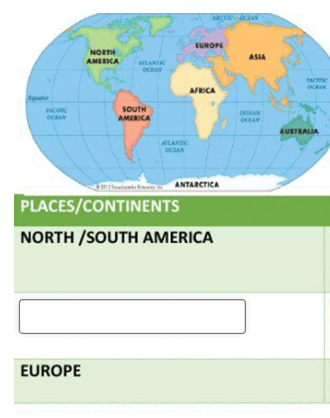
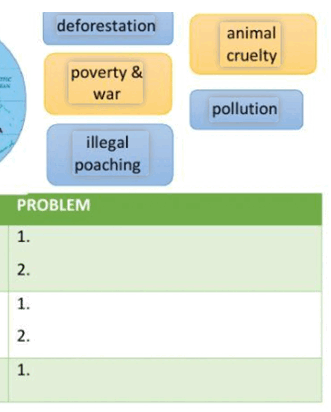
You need to (Group 3) complete the problems mentioned in the song.
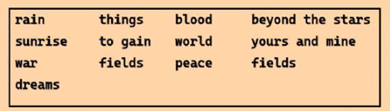
You (Group 4) have to fill in the correct word(s) from the list below
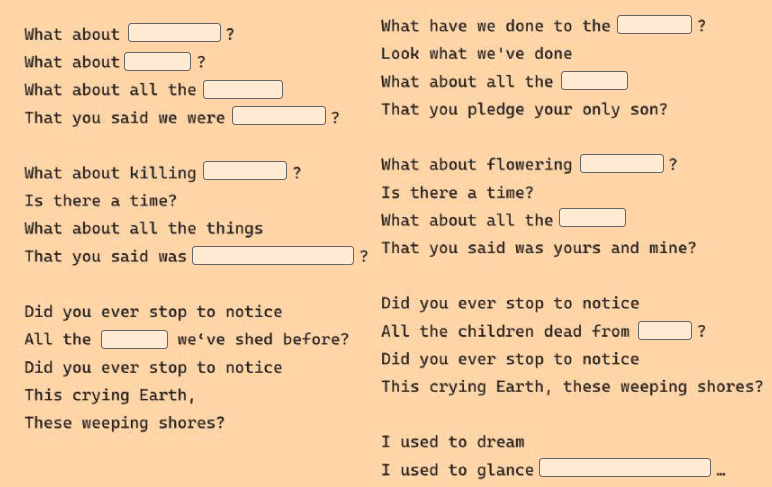
T: Now we will check how you coped with the tasks. Group 1, read us words that you heard. Group 2, name please the continent and show it on the globe, Group 3, name the problems mentioned and Group 4, what word did you put in the first line, next line, last line.
Answer the questions:
Why did the people kneel and start mowing the ground? Did it work?
This short story shows a happy end. Could that be possible in real life? If not what can we do about it?
VIII. Feedback (using the method of Three M)
T: I’m glad to see you are so active, now name three moments which were difficult for you at the lesson and name three moments that surprised you.
Students name them.
T: Thank you. Let’s go back to a self assessment –cards. Fill them please, count your points and rise your hands who has 18-13 - excellent , 12-7 rather well 6-0 – not very good and pass me.
IX. Home-assignment
SLIDE 9
T: Your home task is to create a computer presentation about the most urgent environmental problems (up to 10 slides) or draw an ecological poster.
X. Evaluation and summing up
T: It’s time to finish our lesson. You’ve worked hard and were great. Your marks for today’s lesson will be put after presentation of your posters at the next lesson and checking your listening tasks.
Did you enjoy it? If yes show like if not dislike. (Students show Likes or Dislikes)
SLIDE 10
Thank you for your attention!