My name is Olena. I’m going to talk about teaching reading. The objectives of the workshop are:
1) Objectives
• To establish the importance of teaching reading to students
• To recognize the difference between teaching reading and text analysis
• To explore reading strategies •
To apply the reading strategies to a reading passage
2) We read all the time, even when we do not realize we are doing it. What things you have read in the last week: E-mails, Homework, Shopping lists, The course book, Road signs, Food packets, Magazines, Letters, Novels, Newspapers, Text messages, Notes.
Reading is important in our life. And our students use reading everyday too.
3) Reading is the one of four language skills. It is a receptive skill.
4) When students read they receive and process input from written language. Students can
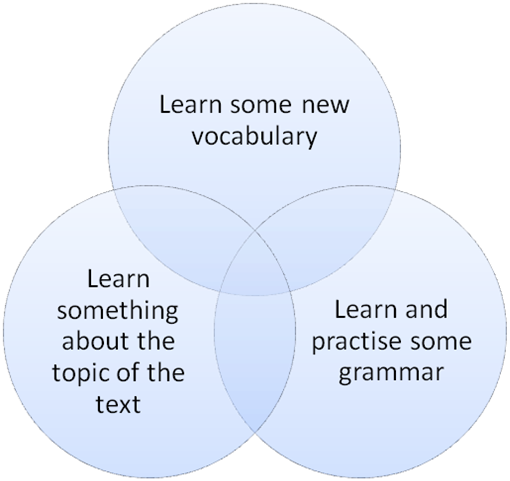
When I choose the text for reading I do a lot of things before.
5) Firstly, the reading text that I give the students to work with must appear to some degree authentic, must be at a levet that students can cope with, even if they do not understand every single word.
Secondly, I choose the kind of the reading material.
6) Just about any kind of reading material is usable in the English teaching classroom. Students can be shown menus and timetables, application forms and emails. They can read poems and narratives, newspaper articles and advertisements, letters and postcards.
7) What I choose to show my students will depend on four things:
■ the students' future needs
■ the students interests
■ the teachers' interests and the textbook they are using
8) There are 3 stages in teaching reading
■ Pre-reading
■ While-reading
■ Post-reading
Let’s start with the pre-reading activities
Teachers have the ability to make potentially boring text interesting (and vice-versa) by the way they introduce the text. That’s why I don’t say my students “Open the books at page 26 and answer question 1 by reading the text". I never ask my students just to read the text because they wouldn't have a reason to read. So, I explain the activity and then they can do it while they are reading. The students will be engaged if the teacher has aroused their curiosity about what they are going to read, looking at the pictures or predicting.
9) Pre reading
So, Pre-reading activities help students prepare for the reading activity. They activate prior knowledge, arouse their interest, and motivate them to read.
10) Pre-reading activities can also help students anticipate the topic, vocabulary and possibly important grammar structures in the texts.
Pre-reading activities include:
Discussion
Quotations
Guessing from words
Guessing from pictures
Guessing from sentences
Videos
Brainstorming
True or False
Introducing vocabulary
KWL Charts
Now let’s work in groups. There is the text on your tables. Read it quickly and prepare one pre-reading activity. (group work)
So, let’s compare your activities.
11) The next stage is While-Reading
When students read they usually need a reason for it. It's the purpose or reason for reading which makes them read in different ways.
Reading quickly to find out the general idea is called skimming. Students read to confirm expectations.
Reading quickly to find very specific information is called scanning. Students read for general understanding.
12) While-ReadingActivities help students focus on aspects of the text and understand it better.
During this stage, students can:
1. confirm predictions
2.gather information
3.organize information
13) While-Reading Activities
• Identify topic sentences and the main idea
• Check whether or not predictions and guesses are confirmed
• Skim a text for general information
• Answer questions
• Scan a text for specific information
• Creating titles or headlines for passages
• Filling in forms with key words
Look at your text again. In groups prepare one activity for while-reading.
Let’s discus your tasks.
14) The third stage is post-reading
Post reading activities help students understand the text further, through critically analyzing what they have read, help them summarize their learning, offer the students the opportunity to make connection with the text. The students read the text slowly again for details. It is called intensive reading. Students read for complete understanding. During the stage I give my students more time for more intensive reading tasks.
15) Post-reading Activities:
• Gap-filling
• Grouping
• Paraphrasing
• Question (ask for clarification)
• Cooperation (discussion, role-play)
• Retelling
• Summarizing (False summarizing)
• Writing
Reading texts contain a great deal of language, topic information
and lots of other information (in accompanying photos or maps, and
through the layout of the text). It would be not sensible to get
students to read and then forget the text and move on to something
else. The part or all of the reading text can be used as a model for
student writing.
I ask my students to work in pairs or small groups to do
different tasks. By doing the activities students get a lot more out of
the text, and there is plenty of learner-to-learner interaction too.
16)
Reading slowly for details is called intensive reading. Students read for complete understanding.
When students understand paragraph and text construction they have a better chance of understanding the text meaning.
17) Key points
• The reading text is the right level for the students;
• The reading topic has some chance of engaging the students' interest;
• The students know what kind of reading they are going to do;
• The tasks suit the next and vice versa
• The students are involved with the topic, the language of the
text and, where appropriate, the text construction;
• Use pre-reading activities, while—reading activities, post-reading activities to the reading text.
18) Principles for teaching reading.
• Teach reading strategies: predicting, skimming, scanning, inferring, guessing eaning from the context, summarizing
• Integrate reading with other skills, e.g. speaking , writing.
There are many Reading and Listening activities which are important for students. They can listens to the CD at the same time as they read the text. This helps students read at a more natural speed and red whole words or blocks of the text. Students do not have to read aloud as they listen, but some students might quietly mouth the words along the CD.
It is important to remember that reading aloud is not really reading skill. Ifs more a speaking skill. Ifs possible to read aloud without understanding what we read. Some students are Most reading that shy and do not want to be embarrassed in front of their friends. students do in class should be silent reading or reading quietly along with the CD).
There are a few times when students read aloud in the classroom:
• Read aloud an example sentence or answer they have written
• Read aloud a line from the text which is the answer to a question
• Read aloud a line or two from a text which they have found interesting
• Read aloud a poem or message they have written
I sometimes go around the class, asking individual learners to read aloud in turn. in this way other students understand clearly: they can hear something as they follow in their textbooks and I can also check their pronunciation.
There are 25 , 27 students in my classes. And the students are not at similar level So I have to prepare different tasks. Instead of choosing 1 activity for the whole class, sets of exercises so that students can work on their own level
19) Remember
Before reading - use the pictures, the objects, the layout, brainstorming so that students know what the text is going to be about.
While reading — make sure the students have a clear purpose and a task to do.
Post reading — talk about the context with the students. Let students read the text again and give them another more intensive reading task or a speaking or writing task. (Talk to them what they have read and ask them what they like best and why).