

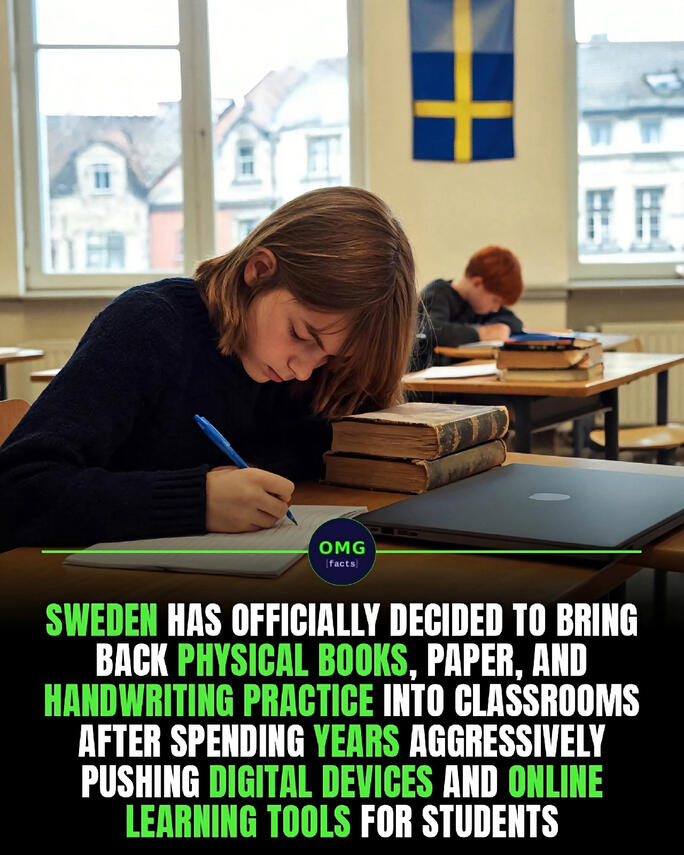
Students in Sweden are trading their touchscreens for textbooks as the nation reverses a decade long push toward total classroom digitization. The move follows years of heavy digital integration, during which tablets and laptops largely replaced traditional learning tools. Education officials now want students to spend more time with paper and pencils, arguing that hands-on work helps build the reading and writing skills that screens can weaken.
📉 Addressing falling literacy rates
The decision followed a clear drop in student reading performance on international assessments. Swedish students still score above the global average, but the downward trend worried policymakers. Researchers and educators have flagged several problems linked to heavy screen use:
* Less focus and concentration because of digital distractions.
* Less time spent on long, immersive reading.
* Weaker handwriting, which is tied to cognitive development.
* Loss of physical contact with texts, which supports spatial memory and comprehension.
🏫 Funding the transition
To pay for the shift, the Swedish government has committed substantial funding so schools can buy printed textbooks. The money is meant to give every student a physical book for every subject, replacing a model where digital platforms were the main source of information. Officials want classrooms where technology is one tool among many, not the center of the day.
🌍 A lesson for the digital age
Other countries that moved quickly to digitize their schools are watching Sweden's reversal closely. The policy has fed a wider debate about how much technology belongs in early childhood education. By putting paper and pen back at the front of the desk, Sweden is betting on methods that produced literate generations for centuries.
Facts checked by @omgfacts
Sources:
Associated Press
The Guardian
The Swedish Ministry of Education