Jade Blue
Jade Blue shares 5 interactive activities to keep our learners communicating, while keeping them safe in the socially distanced classroom.
Classrooms are complex places, influenced by a range of elements. One of the joys (and challenges) of teaching is the need to constantly adapt to the ever-changing context. Patterns emerge in the way we teach, but are never static. To add to this challenge, many teachers will now be returning to classrooms with a new change to respond to: socially distanced seating arrangements.
Holding open class plenary discussions is an obvious way of allowing all learners to contribute while maintaining a physical distance. My post on whole-class discussions will offer a variety of ways of managing this. Unless we find ways to overcome the physical gap and enable our learners to work in pairs and small groups, we risk dramatically reducing their opportunities for communicative practice. So how can we keep our learners communicating, while keeping them safe? Here are 5 activities to keep our learners working together, while still observing the physical gap created in the socially distanced classroom.
#1 – Noisy Café
Asking learners to discuss a topic in pairs can be challenging when social distancing prevents them from sitting next to each other. A noisy café activity allows learners to discuss whatever the teacher asks them to with any person in the room, but without moving from their seat. The only difference between this and more typical pair work activities, is that learners may need to shout over each other to be heard!
With my learners I liken the environment to a noisy bar or café, and allocate each person a partner on the other side of the room for a set time. While it isn’t a quiet activity, noisy café recreates some of the more authentic listening contexts learners may be exposed to around town. Both the novelty factor and freedom of the activity make it a lot of fun.
#2 – Mini Whiteboard Messaging
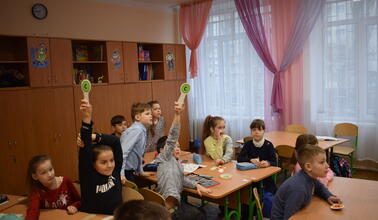
In contrast to noisy café, this activity is carried out largely in silence. Each learner has a mini whiteboard, and works with a partner who can be anywhere in the room – adjacent or opposite, as long as they can see each other. Rather than speaking their conversation, they write it in messages on their whiteboard which they hold up for their partner to read and respond to. What learners write on the boards follows a conversational style, and is written as if it were being spoken. As well as allowing learners to communicate across a distance, this also provides them with more processing time to formulate what they want to say. It also allows the teacher to monitor more closely for errors, supporting learners by holding up notes written on their own mini whiteboard.
#3 – Snowballs
This activity is similar to Mini whiteboard messaging in that learners have a piece of paper and communicate with their partner through writing. After they’ve written something, they screw up their paper like a snowball and throw it across the room to their partner. They then open it, write a response and screw it up again to throw it back.
In another version of snowballs learners collaborate to write and develop a short story. Each learner has a piece of paper with the opening line of a story written at the top, and is given a set time to continue writing. Learners then screw up their paper into a snowball and throw it across the room for another person to continue the story. In this version, learners don’t need an allocated partner as the stories can be continued by anyone.
#4 – Conversation Stations
This activity requires several different ‘stations’ to be set up around the classroom. Each ‘station’ should hold a large piece of paper for learners to write on. Head up each piece of paper with a discussion question related to the same topic. For example, after a reading activity you might choose a number of different questions relating to characters, plot, setting, theme, or style. Write the questions on the whiteboard for all learners to see. Learners then ‘rotate’ around the room, with a set time to write their ideas and responses at each station.
Although the size and layout of the classroom will determine how many stations can be set up, it isn’t necessary to have all learners away from their desks at any one time. Having all the questions on the whiteboard enables those waiting for their turn to be making notes about what they want to write. Adapt this activity for smaller classrooms so that the teacher brings the ‘stations’ to the learners.
#5 – Paper Cup Telephones
As well as being a lot of fun, the wonderful thing about paper cup telephones is that they actually work! Sound vibrations are transmitted along a tightly-pulled string, and each cup acts as both microphone and speaker.
To make the telephone; pierce a small hole in the bottom of a paper cup and thread through a length of string. Secure it on the inside with a knot or paperclip. Attach the other end of the string to a second cup in the same way.
With the string pulled tightly, learners communicate at a distance by speaking into one cup while their partner holds the other to their ear. If you don’t want to spend a lot of time making paper-cup telephones for your class, ask learners to make them at home and bring them into class.