Голос вчителя
iТема тижня: Як я говорю з дітьми про важкі сторінки історії
- Всеосвіта›
- Голос вчителя›
- PMP vs CISSP: Key Differences, Exam Requirements, Costs, and Career Paths

PMP vs CISSP: Key Differences, Exam Requirements, Costs, and Career Paths
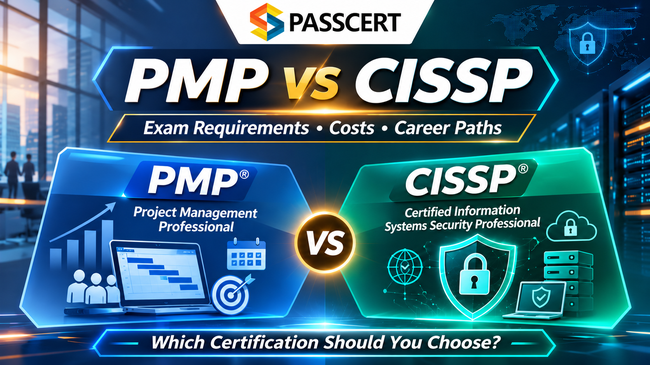
PMP and CISSP are two globally recognized professional certifications, but they serve different career objectives. The Project Management Professional (PMP) certification from PMI focuses on project leadership, delivery, and business value, while the Certified Information Systems Security Professional (CISSP) certification from ISC2 validates advanced cybersecurity knowledge and security management capabilities. For professionals deciding which certification to pursue, understanding their exam requirements, costs, career opportunities, and preparation paths is essential.
1. What Are PMP and CISSP Certifications?
PMP (Project Management Professional) is designed for professionals responsible for leading projects, managing teams, coordinating resources, and delivering business outcomes. It covers predictive, agile, and hybrid project management approaches and is applicable across different industries.
CISSP (Certified Information Systems Security Professional) is designed for experienced cybersecurity professionals. It covers security architecture, risk management, network security, identity management, security operations, and other major areas of information security.
Although both certifications demonstrate professional expertise, PMP emphasizes project leadership, whereas CISSP focuses on cybersecurity strategy, implementation, and governance.
2. PMP vs CISSP: Quick Comparison
Comparison | PMP | CISSP |
|---|---|---|
Full name | Project Management Professional | Certified Information Systems Security Professional |
Certification body | PMI | ISC2 |
Primary focus | Project management and leadership | Cybersecurity and information security |
Target candidates | Project managers, team leaders, program professionals | Security engineers, security managers, architects, consultants |
Experience requirement | Depends on education level; generally 3–5 years | 5 years in at least 2 of 8 security domains |
Exam duration | 240 minutes | Up to 3 hours |
Exam questions | 180 | 100–150 adaptive questions |
Exam fee (U.S.) | $405 member / $655 non-member | $749 |
Renewal cycle | 3 years | 3 years |
Continuing education | 60 PDUs | 120 CPE credits |
Annual maintenance fee | No separate annual AMF | $135 |
Main career direction | Project and program leadership | Cybersecurity and security leadership |
Exam fees are U.S. published prices and may vary by location, taxes, and applicable policies. The PMP examination information reflects the 2026 version.
3. PMP vs CISSP: Exam Requirements
One of the most important differences is the professional experience required before candidates can earn these certifications.
PMP Exam Requirements
PMI offers different eligibility pathways based on educational background:
Education | Project Management Experience |
|---|---|
High school diploma or equivalent | 60 months |
Associate degree or equivalent | 48 months |
Bachelor's degree or higher | 36 months |
Degree from a PMI GAC-accredited program | 24 months |
Candidates must also complete the required project management education or training.
PMP is suitable for professionals who have already participated in leading and managing projects and want to validate their ability to deliver results across different project environments.
CISSP Exam Requirements
CISSP has a more specialized professional experience requirement.
Candidates generally need:
● Five years of cumulative, full-time professional experience.
● Experience in at least two of the eight CISSP domains.
● An endorsement from an ISC2-certified professional in good standing, subject to ISC2 requirements.
A relevant four-year degree or an approved credential may waive up to one year of the experience requirement.
Candidates who pass the CISSP examination but do not yet meet the experience requirement may become an Associate of ISC2 and have up to six years to complete the required experience.
4. PMP vs CISSP: Exam Topics and Knowledge Areas
The two certifications assess substantially different professional competencies.
PMP Exam Domains (2026)
The updated PMP examination, launched on July 9, 2026, uses three major domains:
Domain | Weight |
|---|---|
People | 33% |
Process | 41% |
Business Environment | 26% |
The updated examination places greater emphasis on business value, organizational strategy, governance, and the practical application of project management skills.
Candidates should also understand predictive, agile, and hybrid approaches, as well as the role of AI and sustainability in modern project environments.
CISSP Exam Domains
The CISSP examination covers eight cybersecurity domains:
Domain | Main Knowledge Areas |
|---|---|
1. Security and Risk Management | Security governance, risk management, compliance |
2. Asset Security | Data classification, ownership, protection |
3. Security Architecture and Engineering | Security models, cryptography, secure design |
4. Communication and Network Security | Network architecture, protocols, secure communications |
5. Identity and Access Management | Authentication, authorization, access control |
6. Security Assessment and Testing | Security audits, assessments, testing |
7. Security Operations | Incident response, disaster recovery, monitoring |
8. Software Development Security | Secure development lifecycle, application security |
CISSP candidates need both technical knowledge and an understanding of how security decisions affect organizational risk and business operations.
5. PMP vs CISSP: Exam Costs and Maintenance
Certification costs are another important consideration, particularly for professionals planning to earn and maintain their credentials over several years.
Cost Item | PMP | CISSP |
|---|---|---|
U.S. exam fee | $405 member / $655 non-member | $749 |
Annual maintenance fee | No separate annual AMF | $135 |
Renewal period | 3 years | 3 years |
Renewal requirement | 60 PDUs | 120 CPE credits |
Additional expenses | Training, membership, study materials | Training, study materials, CPE activities |
Which certification costs more?
CISSP has a higher initial examination fee and a recurring annual maintenance fee. PMP has different examination prices for PMI members and non-members, so candidates should compare the membership cost with the available examination discount.
For CISSP, the examination fee plus three annual maintenance payments amounts to approximately $1,154 over the first three-year period, excluding training and study materials.
For both certifications, preparation expenses depend on whether candidates choose self-study, instructor-led training, or additional practice resources.
6. PMP vs CISSP: Career Opportunities
The most important consideration when choosing between PMP and CISSP is the type of professional responsibility you want to develop.
Careers After Earning PMP
PMP is relevant to professionals pursuing project leadership and management positions, including:
● Project Manager
● Program Manager
● Project Management Office (PMO) Manager
● IT Project Manager
● Delivery Manager
● Operations Manager
● Business Transformation Manager
It is particularly relevant to professionals managing technology implementations, infrastructure projects, business transformation, and cross-functional teams.
Careers After Earning CISSP
CISSP supports career development in cybersecurity and information security, including:
● Information Security Manager
● Security Architect
● Cybersecurity Consultant
● Security Engineer
● Information Security Director
● Security Operations Manager
● Chief Information Security Officer (CISO)
It is especially relevant to professionals responsible for security strategy, enterprise risk, security architecture, and organizational security programs.
7. PMP vs CISSP: Which Certification Should You Choose?
There is no universal answer because the two certifications support different career directions.
Your Background or Career Goal | Certification to Consider | Why |
|---|---|---|
You manage projects and cross-functional teams | PMP | Develops and validates project leadership capabilities |
You work in cybersecurity or information security | CISSP | Validates broad security knowledge and professional experience |
You want to become a project or program manager | PMP | Directly aligns with project delivery responsibilities |
You want to become a security architect or security manager | CISSP | Covers enterprise security and risk management |
You work in IT operations and want to move into project leadership | PMP | Helps demonstrate project management competencies |
You want to advance into cybersecurity leadership | CISSP | Supports security strategy and management responsibilities |
For IT professionals, the distinction is particularly important. Working in IT does not automatically mean CISSP is the right choice. If your responsibilities involve coordinating infrastructure upgrades, managing implementation schedules, and delivering technology projects, PMP may be more relevant.
On the other hand, if you are responsible for security assessments, risk management, network protection, or enterprise security architecture, CISSP is more closely aligned with your professional background.
8. Can You Earn Both PMP and CISSP Certifications?
Yes. PMP and CISSP are complementary certifications rather than competing credentials.
Professionals working in enterprise IT, cybersecurity transformation, security consulting, and large-scale technology programs may benefit from understanding both project management and information security.
For example, a cybersecurity project manager may need to coordinate security implementation projects, manage project resources, communicate with stakeholders, and understand security risks. PMP supports the project leadership side, while CISSP provides a broader security knowledge foundation.
However, earning both certifications requires separate preparation, qualifying experience, examination fees, and ongoing maintenance.
Candidates should prioritize the certification that most closely matches their current responsibilities and next career objective.
9. How to Prepare for PMP and CISSP Exams
Although PMP and CISSP require different knowledge, an effective preparation strategy for either examination should combine official exam objectives, structured learning, and practice questions.
For PMP candidates:
1. Review the 2026 PMP Examination Content Outline.
2. Understand the People, Process, and Business Environment domains.
3. Study predictive, agile, and hybrid project management approaches.
4. Practice scenario-based questions involving project decisions and stakeholder management.
5. Review incorrect answers and understand why alternative choices are less appropriate.
For CISSP candidates:
1. Review the current ISC2 CISSP Exam Outline.
2. Study all eight security domains systematically.
3. Understand security concepts, risk management, and enterprise security architecture.
4. Practice scenario-based questions that require applying security principles.
5. Review explanations to strengthen both technical knowledge and management-level decision-making.
PMP Practice Tests and CISSP Practice tests can help candidates evaluate their understanding, identify knowledge gaps, and become familiar with different question scenarios before taking the official examinations.
10. PMP vs CISSP: Frequently Asked Questions
Q1: Is PMP harder than CISSP?
They are challenging in different ways. PMP emphasizes project management decisions, leadership, and business scenarios. CISSP requires broad cybersecurity knowledge and the ability to apply security concepts across multiple domains. The difficulty depends on each candidate's professional background.
Q2: Can I take CISSP without five years of experience?
Yes. You can pass the CISSP examination and become an Associate of ISC2 if you do not yet meet the full experience requirement. You will have up to six years to gain the required professional experience.
Q3: Is PMP useful for IT professionals?
Yes. PMP is relevant to IT professionals who manage technology projects, infrastructure implementations, software delivery, cloud migrations, and digital transformation initiatives.
Q4: Is CISSP only for cybersecurity engineers?
No. CISSP is also relevant to security managers, architects, auditors, consultants, and senior IT professionals involved in enterprise security decisions.
Q5: Can I earn PMP and CISSP together?
Yes. There is no general restriction preventing professionals from earning both. They validate different competencies and can complement each other in roles involving technology project delivery and security management.
Q6: Which certification should beginners pursue first?
Candidates should start by identifying their career direction and checking the eligibility requirements. PMP requires documented project leadership experience, while CISSP requires qualifying cybersecurity experience for full certification. Candidates without the required CISSP experience may pursue Associate of ISC2 status after passing the examination.
PMP vs CISSP: Making the Right Certification Decision
PMP and CISSP serve different professional purposes. PMP validates project leadership and the ability to deliver business outcomes, while CISSP demonstrates broad cybersecurity expertise and security management knowledge.
For candidates choosing their next certification, the best starting point is to evaluate their existing experience, current job responsibilities, and long-term career goals. Understanding these differences before registering can help avoid unnecessary preparation costs and build a more focused professional development plan.


