ВП НУБіП України
«Мукачівський аграрний коледж»
Конспект
відкритого заняття
з предмету «Іноземна мова за професійним спрямуванням»
(англійська)
на тему
«Юридичні спеціальності Великобританії»
Підготувала
Возняк В.М.
Мукачево 2019
Legal professions in Great Britain
Objectives: to realize the meaning of two notions as a barrister and a solicitor; to explain the main difference between these two professions; to encourage students to choose a suitable job for them in a legal area
Procedure:
I. Greeting:
Good morning! Take your seats.
We have a deal with serious topic under the title ‘Legal professions in Great Britain’
Who is absent today?
Who is on duty today?
II. Checking the homework
Give English equivalents of the following Ukrainian words and word combination.
Task 5 p. 46
Професiйна пiдготовка; готувати спецiалiстiв; адвокатура; людськi долi; нотарiус; суддя; юридична установа; Мiнiстерство внутрiшнiх справ; прокуратура; мати справу з людьми; легка робота; слуга народу; взаємовiдносини людей; служити людям; товариське спiвробтництво; злочиннi явища; вести боротьбу; проявлятися; рішуча боротьба; карати злочинця; запобiгати злочину;
Task 7. P.47
Translate into English.
1. Юристiв готують в юридичних iнститутах та на юридичних факультетах деяких унiверситетiв.
2. Юристам доводиться мати справу з людськими долями, a це нелегка робота.
3. Боротьба з злочиними явищами складається перш за все з попередження злочинностi у викорiненнi причин та лiквiдацiї умов, якi породжують цi явища.
4. Щоб забезпечити принцип не уникнення покарання, необхiдно швидко знайти злочинця та ретельно розслiдувати справу.
5. Щоб впоратись з своєю вiдповiдальною роботою юристу необхiдний високий загальноосвітнiй рiвень та хороша професiйна пiдготовка.
III. WARM-UP
Legal professions in England and Wales are divided between two distinct branches under the legal system, those of solicitors and barristers. Solicitors are qualified lawyers who advise the person and help prepare the defence case. Barristes are considered in more serious cases, or where there are special difficulties. The barrister is trained in the law and in the skills required to argue a case in court.
IV.Presenting vocabulary
Advocacy – захист
Art of advocacy – мистецтво захисту
To attain – досягати
Bar Council – Рада адвокатів
Barrister – адвокат вищого рангу, який має право виступати в суді
Chamber – контора адвокатів
Conveyance – передача правого титулу
Conveyaing – складання нотаріальних договорів
Dictinction – відмінність
Estate – майно, власність
Inferior court – суд нижчої інстанції
Inns of Court – школи підготовки баристів
Law Society – Правове суспільство
Mantrimonial – шлюбний
A real degree of objectivity – дійсна ступінь об’єктивності
Solicitor – адвокат, без права виступу в суді (нижча категорія адвокатів в Англії)
V. Reading
Read and translate the following text
LAWYERS IN THE UK
Solicitors and Barristers
The most striking feature of the English legal profession is its division into two separate sub-professions- barristers and solicitors. Barristers are different from solicitors. Barristers are court- room lawyers and solicitors are office-lawyers.
If a person has a legal problem, he goes to see a solicitor. Almost every town has at least one. In fact, there are about 60,000 solicitors in Britain. Many problems are dealt with exclusively by a solicitor. For instance, the solicitor deals with petty crimes.He may represent his client in the lower courts and some matrimonial matters in magistrates’ courts. He prepares the case and the evidence: interview clients and witnesses. In a civil action, he can speak in the county court, when the case is one of divorce or recovering some debts. Besides, a solicitor deals with other matters. He does the legal work involved in buying a house; he writes legal letters for you, he helps you to make a will, etc.
Barristers are experts in the interpretation of the law. They advise on really difficult points, and conduct legal proceedings in the higher courts. Barristers are rather remote figures. A barrister’s client can come to him only via a solicitor. They are not paid directly by clients but are employed by solicitors. Barristers do not have public offices in any street. They work in chambers, often in London. There are about 6,000 barristers in England. Usually only barristers can become judges in English courts
VI. Speaking
Answer the following questions.
1. Do England and Wales compose a single legal jurisdiction?
2. What is the legal profession in England and Wales made up of?
3. Did these professions traditionally have very distinct roles?
4. What matters does a solicitor deal with?
5. Do all solicitors work in private practice?
6. Does the training of solicitors take a short time?
7. What is required to become a solicitor?
8. What rules does the Law Society make?
9. What kind of education must the trainee receive?
10. Are barristers different from solicitors?
11. What services do barristers offer?
12. What kind of right has a barrister?
13. Has a barrister a direct contact with a client?
14. How do barristers earn their living?
15. How does a barrister attain a real degree of objectivity and of independence of mind?
16. Are barristers allowed to form partnership?
17. What do you have to do to qualify as a barrister?
18. What does barristers’ training concentrate on?
19. What institution educates and regulates barristers?
20. Are barristers and solicitors required to dress formally when appearing in a court case?
VII. Listening . Watch video material and do the following tests
Post-Listening Tests
Carrier Advice on Becoming a Trainee Solicitor
1)Why did he choose legal profession?
a) because of interest
b) because of parents’ advice
c) because of variety
d) because of high salary
2) How often should a trainee change his job?
a) every 5 months
b) every 4 months
c) every 2 months
d) every 3 months
3) What is the term of law contract?
a) 12 months
b) 20 months
c) 14 months
d) 24 months
4) How old was Michael when he left his home?
a) 18
b) 20
c) 13
d) 12
5) Was his first year difficult for him?
a) Yes
b) No
c) I don’t know
6) What was parents’ advice according his future occupation?
a) to become an economist
b) to become a doctor
c) to become a lawyer
d) to become a computer programmer
7) Has he refused from parental proposal?
a) No, he hasn’t
b) Yes, he has
8)Why did he give up doing Maths?
a) he changed his mind because of less interest in it
b) it was boring for him
c) he wanted a good life and work balance
d) a job of an economist isn’t so prospective
9) What was the result of gap year for him?
a) pride, encouragement and sense of liberty
b) sense of appreciation for freedom and liberty and motivation in work
c) to try something in order to get more experience
d) to get high salary and luxury life
10) What is his aim according to his profession?
a) to make some changes for science and politics
b) to have a privilege job
c) to be involved in shaping society in a certain way
d) to become only the part of charity organizations
VIII. Vocabulary Exercises
Focus on the particular daily activities of barristers and solicitors and match the following verbs and nouns. Mark who performs each activity: a solicitor (S), a barrister (B), or both (S,B).
provide advise take brief draft research and analyze
supervise plead represent hold negotiate calculate
_____________________ specialist legal advice
_____________________ documents
_____________________ claims for damages
_____________________ the implementation of agreements
_____________________ instructions from clients
_____________________ clients in court
_____________________ a barrister
_____________________ documents, letters, contracts, wills
_____________________ cases in court
_____________________ conferences with clients
_____________________ settlements
______________________ clients
Task 5. Complete the following expression choosing a suitable preposition; find the best way of expressing them in Ukrainian.
interpretation _____ the law
needs ______ the client
matters ______ law
presentation _____civil / criminal cases
to deal ______ matters
to make the rules _____ the legal training
experts _____ advocacy
a direct contact ______ a client
two branches _____ the profession
a member _____ the Inns of Court
art _____ presenting cases
to qualify ______ a barrister
exclusive right _____ audience
to work _____ private practice
Task 7. Make the following sentences complete by translating the phrases in brackets.
1. Some (солісітори) qualify for (виключне право виступати) in the higher courts, with some City firms encouraging this.
2. The vast majority of barristers’ (адвокатських контор) are to be found in major towns and cities whereas there’s a firm of (солісіторів) on practically every high street.
3. (Барістери) are expected to conform to high standards of dress, ethics and (професійної) conduct.
4. For many barristers, the eventual aim is to become a (королівським адвокатом) (QC), which involves leading in very serious
(справах), or entering the (судові органи) as an assistant recorder prior to becoming a (суддею).
5. Solicitors have rights of audience in the (нижчих судах) and although many do no (захист) some do a substantial amount.
6. A (солісітор) has overall conduct of a (справи) and develops a working (відносини) with the (клієнтом), which can be rewarding.
7. A (барістер) may have little opportunity (розвивати відносини) with the client.
8. Solicitors are employed by their firms and receive a regular (зарплату) – if they become (партнерами), they will essentially ‘own’ part of the firm and be awarded a percentage of its (прибутків).
9. Barristers, on the other hand, are (працюють не за наймом) and are (відповідальні) for their own finances – they must do their (рахунки themselves or hire an accountant for that purpose.
10. (Судові Інни) are independent societies that are titularly responsible for the training, admission (calling) and discipline of barristers.
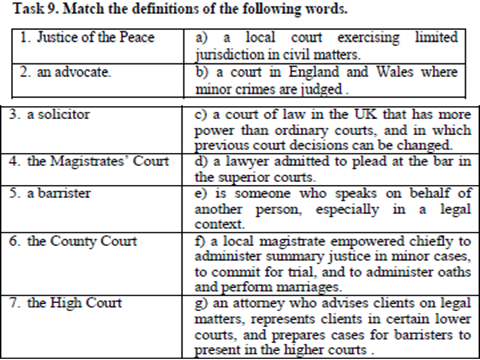
IX. Grammar
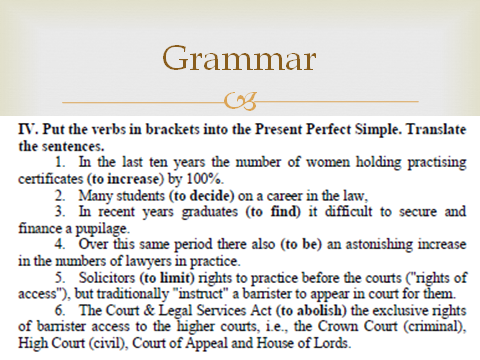
XI. HOMEWORK:
P. 119 ex. 6
P.123 ex. 2
Write an essay about the following topic ‘Lawmakers shouldn’t be lawbreakers’
XII. Summarizing
What are the most popular professions in UK?
Who is a barrister?
Who is a solicitor?
What is the main difference between them?