Цілі: вдосконалювати навички вживання нових лексичних одиниць; вдосконалювати навички усного мовлення, аудіювання й читання; розвивати мовну здогадку та мовленнєву реакцію учнів; розвивати пам'ять; прищеплювати любов до навколишнього світу; виховувати зацікавленість у розширенні своїх знань.
Can you talk about Environmental issues in English? In pairs, try to explain the terms in the diagram below. Why are the words divided into two groups — in different shapes?
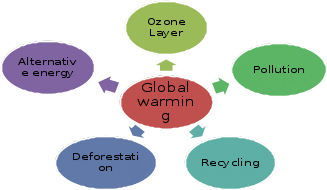
Dо ex. 1, p. 152.
Try to answer questions before listening. Note your answers briefly.
Key (example):
1) a greenhouse effect and global warming;
2) wind energy and solar energy;
3) a natural process that is millions of years old which increases the temperature of the Earth;
4) oxygen;
5) recycle;
6) ice caps melting, climate change.
Do ex. 2 a, b, p. 153.
1. What is our planet and nature for us? (Environment)
2. What is the greenhouse effect? (It is a natural process that warms the Earth's surface).
3.Name at least two examples of climate change. (Global warming and deforestation).
4. Name at least two consequences of global warming. (Increase in temperature rising sea levels)
5.Which of these gases is not a greenhouse gas: carbon dioxide, methane or oxygen? (Oxygen)
6. Complete the three Rs that are important for the future of our planet (reduce, reuse and recycle).
7. Name at least two types of renewable energy. (The wind and the sun).
8. How do we name a thick forest in tropical parts of the world? (Rainforests)
9. Name the most known organization which protects our environment. (Greenpeace)
10. Name the science that studies the relation of plants, animals and people to each other and to their environment. (Ecology)
Listen to the quiz and put the questions in the correct order.
Listen again and check your answers.
2.1 Puzzle "Environment"
Find the words below in the puzzle.
Pollution, rubbish, climate, species, icemelting, rainforest, protection, ecology, garbage, oxygen.
j | q | V | | r | e | p | r | e | X | m |
i | g | n | k | a r | c | r | k | p | k | r |
c | a | X | P | i | 0 | h | b | r | h | m |
e | r | c | 0 | n | 1 | o | h | 0 | y | q |
m | b | 1. | 1 | f | 0 | X | j | t | r | s |
e | a | i | 1 | o | g | y | m | e | u | P |
1 | g | m | u | r | y | g | m | c | b | e |
t | e | a | t | e | j | e | y | t | b | c |
i | V | t | i | s | V | n | w | i | i | i |
n | 0 | e | 0 | t | f | w | u | 0 | s | e |
g | X | 1 | n | w | e | b | r | n | h | s |
Find out the words’ definitions, p. 153; use a dictionary if necessary.
A container — контейнер Survival — виживання
Oxygen — кисень Waste — витрачати
A surface — поверхня Coastal — прибережний
Do ex. 3 a, p. 153. Make notes.
My name is Dee West. I am a director of the Environmental Services for the clean and beautiful programme in Alpharetta, Georgia. I have been the director of Environmental Services since 1989.
My responsibility is to educate the people about environmental issues. We also have schools called the Green Schools. These schools were created in 1991. Over 23,000 children attend the Green Schools. These children learn how to protect the environment, clean lakes and rivers and how to test the quality of water. The children now know that they should not litter. That means they should not throw their trash in the streets or parks. They also learn that a lot of their trash can be recycled. Things such as tins, steel and aluminium cans, glass, some plastics, newspapers, and magazines can be made into new products. Office paper, tires, and telephone books can be also recycled.
It is really important for saving our trees from cutting. You can start protecting trees by recycling paper products in your country, too.
5. Speaking
6. Reading & Writing
Do ex. 4, p. 154.
Fill in the table using the greed from p. 154.
Material | Objects | What we have to do |
Plastic | | |
Metal | | |
Aluminum | | |
Cloth | | |
Glass | | |
Paper | | |
Rubber | | |
Do ex. 3 b, p. 154 in pairs.
Listening
Do ex. 6 a, b.
L o v r o. Dora! You left the light on in the bathroom again!
Dora. Sorry, I’ve forgotten.
Lovro. You’ve forgotten! You never think about turning off the tap whi' brushing your teeth.
D o r a. I need much more water than you!
Lovro. It’s quite absurd. Do you have more teeth than me? Then, you alwa; bring too many plastic bottles from the supermarket. And never put empty om into the litterbin.
Dora. Don’t be angry, Lovro! I’ll not be like that any more.
Lovro. I’ve heard it a dozen of times! But you continue to take a bath inste« of shower and you always have excuses.
D o r a. I like to swim!
L o v r o. In a bath?! And you again turn up heating. It’s warm outside now. I the way, don’t forget to switch off the TV, when you go to your club.
Part b key: 1 g, 2 f, 3 h, 4 a, 5 b, 6 c, 7 d, 8 e.
Summary
Do ex. 5, p. 155.
Homework
Do ex. 7a, b, p. 156.